# How Cisalfa Group got its catalog ready for the new season without growing the team
> Cisalfa Group, the largest sports retailer in Italy and Germany with 240+ stores and roughly 20,000 SKUs, cleared the FW26 season step change without growing its catalog team. Close to 20% of the catalog is private label and the qualifying attributes do not live in the ERP, so the content has to be generated rather than copied, and produced twice, once for the Cisalfa Sport site and once for the Intersport-network catalog. An agent pipeline mirrored 1:1 on the customer’s Akeneo normalizes, enriches, applies the rules and generates both channel variants, with a CommerceClarity Retail Engineer embedded in the team. In the first quarter it saved 84.7% of the time per style against a 50% target, generated 2,563 styles, and lifted the mandatory-attribute match from 86.0% to 93.2%.
**Hero figure value:** 84.7%
**Hero figure label:** Time saved per style, against a 50% target
**Industry:** Sports retail
## Key figures
- 84.7% · time saved per style, against a 50% target
- 2,563 · styles generated in the first quarter
- 93.2% · mandatory-attribute match, up from 86.0%
## Agents
- Data Enrichment
## The challenge
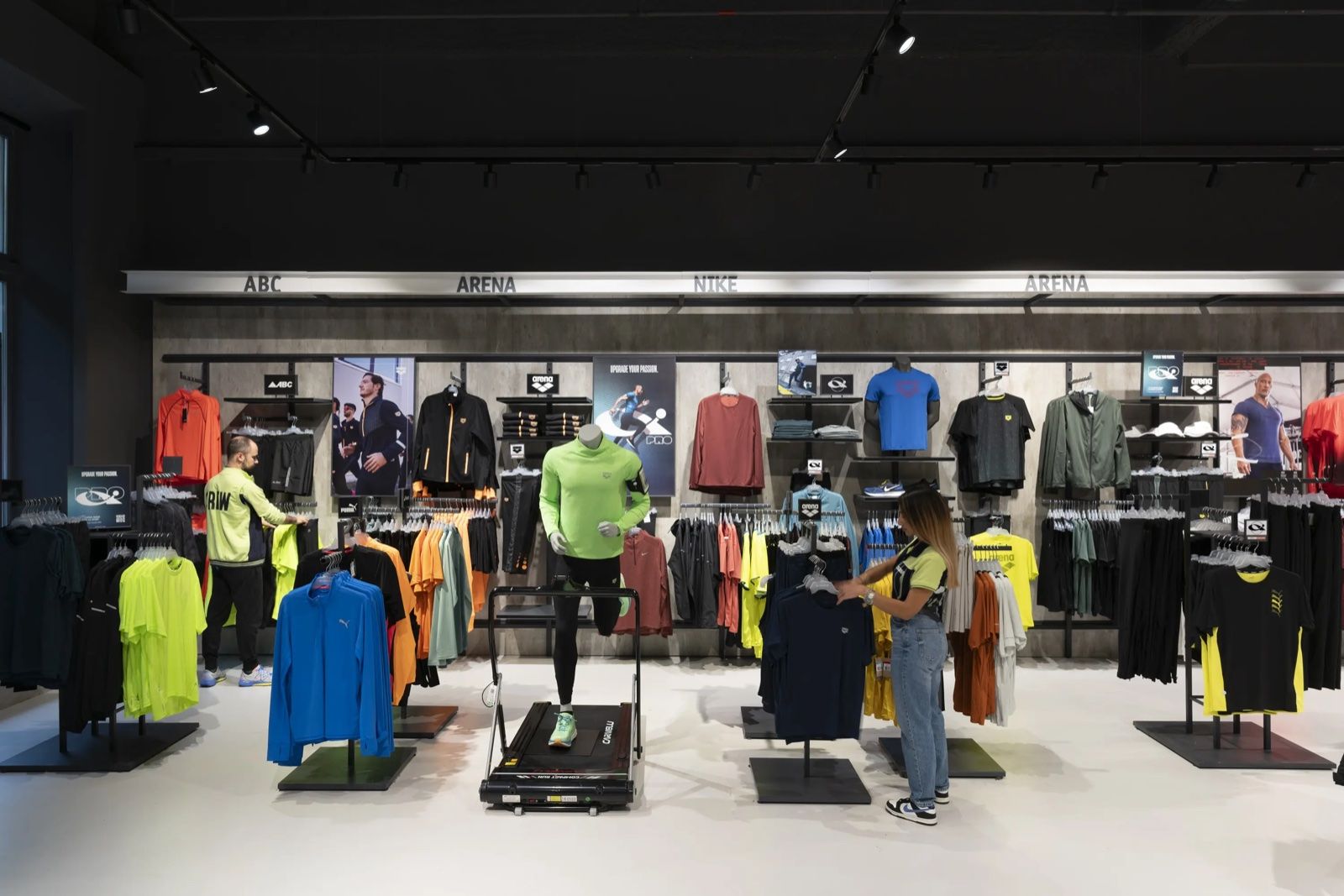
Cisalfa Group is the largest sports retailer operating in Italy and Germany: 240+ stores across 18 regions, around 5,200 employees, and a catalog of roughly 20,000 SKUs spanning 280+ third-party brands plus its own private-label portfolio, ABC, Admiral, Arena, Dack’s, Fila and Performer. In Italy it sells through two distinct storefronts, the Cisalfa Sport brand site and the Intersport-network catalog, each with its own schema, naming and language conventions. The platform stack runs on an Akeneo PIM feeding Salesforce Commerce Cloud.
The catalog work was hard for reasons that compounded.
1. **Close to 20% of the catalog is private label**, so the content cannot be pulled from a brand feed. It has to be constructed in-house from sparse internal data.
1. The attributes that actually make a sports product sellable, the **qualifying attributes** like fit, composition and material, mostly **do not live in the ERP**, so they have to be generated rather than copied.
1. On the third-party side, only about **half of the brand catalog cleanly matched** Cisalfa Group’s own schema, which left a large manual reconciliation gap.
1. Every product has to be produced **twice**, once for Cisalfa Sport and once for Intersport, against two different sets of field names and rules.
On top of the catalog itself, time was the binding constraint. Time-to-market at Cisalfa Group is measured as the share of SKUs complete against warehouse arrivals, with a bar above 95%.
The FW26 season meant a step change in volume, and the catalog had historically been run by a small, junior-heavy copy team of one to two people for 20,000 SKUs. Hitting FW26 the old way would have meant multiplying the manual effort rather than removing it.
Cisalfa Group wanted the opposite: to clear the FW26 step change at a higher quality bar, without growing the team. More catalog, not more people.
### The setup before CommerceClarity
Cisalfa Group ran its catalog on the systems built for its retail and store business. Product data lived in Akeneo, designed to hold specifications and feed the storefronts, not to generate sellable, channel-ready content.
Around that system ran a fully manual operation.
- Catalog copy and attributes were produced **100% in-house**, by a small team of one to two people for around 20,000 SKUs.
- Quality was tracked as **binary completeness**: an attribute was either present or absent, with no notion of richness or accuracy.
- There was no internal capacity to build the dashboards that would have exposed the gap.
- Every additional brand, channel or attribute group meant another full round of manual enrichment and checking, run once for Cisalfa Sport and once for Intersport.
**The model worked, but it did not scale.**
## How CommerceClarity solved it: AI agents and Retail Engineers
CommerceClarity slotted into the existing stack with no rip-and-replace. The configuration was set up as a 1:1 mirror of Cisalfa Group’s Akeneo, so generated content exports straight back in a compatible format, and supplier-portal files are ingested directly instead of being reworked by hand.
### The agents bring the scale
Each product starts as a single canonical record, and an agent pipeline carries it from raw input to channel-ready content, every step building on the one before it.
1. **Normalize.** Map heterogeneous inputs, ERP fields, supplier-portal files and brand feeds, into Cisalfa Group’s taxonomy and hierarchy.
1. **Enrich.** Generate the qualifying attributes the ERP does not carry, fit, composition, material and the like, which is where Cisalfa Group sees the real added value.
1. **Apply rules.** Enforce brand voice, channel constraints and the agreed data model, so the taxonomy-driven attributes come back correct by construction.
1. **Generate channel variants.** Reshape the single source into both the Cisalfa Sport and the Intersport formats, each with its own schema and naming.
1. **Validate.** Score quality, run the automated checks, and surface only the exceptions that need a human eye.
Cisalfa Group did not switch all of this on at once. They started where the pain was sharpest, end-to-end generation for both Cisalfa Sport and Intersport, then layered in direct supplier-file ingestion and the Akeneo mirror, with per-attribute enrichment and exception-only review following on.
### The Retail Engineers co-build the outcome
The agents do not run alone. A CommerceClarity Retail Engineer works as an extension of Cisalfa Group’s team, the same person scoping, building and shipping inside the way the company already operates rather than handing work across siloes.
That flipped the operating model. The old way was manual and regression-prone, a small team checking every product and every change by hand. With the agents and the Retail Engineer in place it became governed and exception-only: the team reviews only what the pipeline flags, every run is traceable, and unreliable sources are excluded by construction. The agents bring the speed and the scale, and the people keep the governance over what actually ships.
## What is next
With the foundation in place, the work has shifted from building it to building on it: scaling FW26 volumes through direct supplier-file upload with no rework, driving rework toward zero with exception-only review and per-attribute correction, and going beyond text with an image workflow built to Cisalfa Group’s guidelines and coordinated outfits drawn from the catalog.
From here the partnership continues the way it started, side by side. A CommerceClarity Retail Engineer and Cisalfa Group’s team find the next bottleneck together, build the agents that clear it, and turn more of the catalog into revenue.
## Before and after
The first quarter of work in a single view.
- Time per style · Fully manual · 84.7% saved, about 18 minutes a style, against a 50% target
- Throughput · 1 to 2 people for around 20,000 SKUs · About 30 products a day at 3 to 5 minutes each, 2,563 styles in Q1
- Mandatory-attribute match · Binary completeness only · 86.0% to 93.2%, scored per attribute
- Channels · Produced by hand, per storefront · Cisalfa Sport and Intersport generated from one source
- Operating model · Internal team, reactive, regression-prone · Agents and an embedded Retail Engineer, exception-only review, fully traceable
## More catalog, not more people
*In their words*
### Francesco Gasca
As our catalog continued to grow in both volume and complexity, we needed a new way to scale without simply adding resources. Together with CommerceClarity, we built a model that combines AI-powered automation with strong governance, enabling us to manage more products, improve data quality and accelerate time-to-market without expanding the team. The real value goes beyond efficiency: it allows our people to focus on higher-value activities while giving us a stronger, more scalable foundation for future growth.
Chief Digital & Omnichannel Officer, Cisalfa Group
## Proves area
## More customer stories
## See what the agents do with your catalog
Bring one messy feed, or the backlog of products you never got to. We will show you the rest.
## Questions
### What changed for Cisalfa Group?
In the first quarter, 84.7% of the time per style against a 50% target, which is about 18 minutes saved on every style. 2,563 styles were generated, and the mandatory-attribute match went from 86.0% to 93.2%. The team did not grow.
### Why was this catalog harder than most?
Close to 20% of it is private label, so the content cannot be pulled from a brand feed and has to be built in-house from sparse internal data. The attributes that make a sports product sellable, fit, composition and material, mostly do not live in the ERP. And every product has to be produced twice, once for the Cisalfa Sport site and once for the Intersport-network catalog, against two different schemas.
### How are two storefronts handled without doing the work twice?
Each product is one canonical record. The pipeline generates the channel variants from it, reshaping the same source into the Cisalfa Sport and the Intersport formats with their own field names and rules, so the work is done once and shaped twice.
### Did Cisalfa Group have to change its systems?
No. CommerceClarity slotted into the Akeneo and Salesforce Commerce Cloud stack that was already running, with no rip-and-replace. The configuration is a 1:1 mirror of Cisalfa Group’s Akeneo, so generated content exports straight back in a compatible format, and supplier-portal files are ingested directly instead of being reworked by hand.
### How big is the catalog behind this?
Cisalfa Group runs 240+ stores across 18 regions with around 5,200 employees, and a catalog of roughly 20,000 SKUs spanning 280+ third-party brands plus its own private-label portfolio.
## Entities
- Francesco Gasca · Person, mentions
## Sources
---
Canonical: https://commerceclarity.com/customers/cisalfa-sport
Every page of this site is available as markdown: append `.md` to its path. Index: /llms.txt
](https://cdn.sanity.io/images/xd4hrbt2/production/0c616d65d16e53545599d30c95b7c6a987a3a86b-1600x1067.jpg?auto=format)