# GEO vs SEO vs AEO: what changes for retailers?
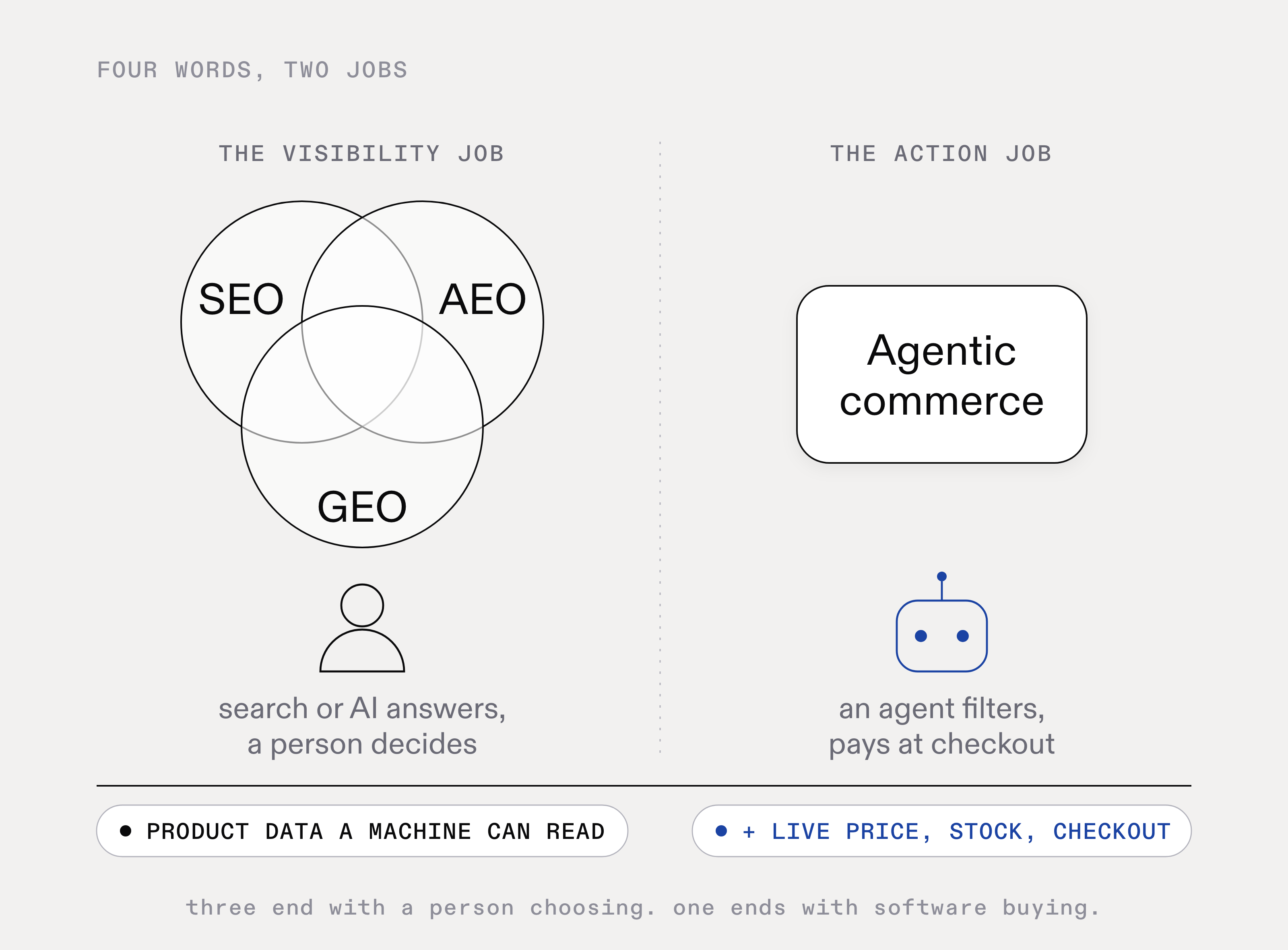
> SEO helps a page rank in search, AEO makes content useful as a direct answer, and GEO aims for inclusion in AI-generated answers. The three overlap and share the same product facts. Agentic commerce is a different job: an agent checks price, stock and delivery and proceeds with the order within the customer's limits. Start with one category and ten real buying questions, and fix the product data where each one breaks.
SEO, AEO and GEO help shoppers find and choose products. Agentic commerce adds software that acts on the customer's instructions, up to the order.
**Published at:** 2026-10-13T09:46:24Z
A customer needs a washing machine that fits a shallow space, costs less than €600 and can arrive next week. They might search Google for suitable models, ask an AI assistant to compare them, or ask it to arrange the purchase.
Your store could appear in the search and the comparison, then lose the order because delivery takes three weeks. Each step needs different information.
Search engine optimization (SEO), answer engine optimization (AEO) and generative engine optimization (GEO) help people find and choose products. Agentic commerce adds the ability to carry out shopping tasks within the customer's instructions.
The work shares much of the same product data. What you fix depends on where the customer gets stuck.
*SEO, AEO and GEO help a person choose. Agentic commerce also needs live price, stock and checkout, because the agent completes the order.*
## SEO vs GEO vs AEO: what is the difference?
The boundaries overlap. An AI assistant can use your installation guide in a direct answer and in a longer comparison. Both depend on it finding and understanding the information.
A shopper who sees your store in an answer may visit it, or get enough information to stop there. Track the citation, but keep it separate from visits and sales.
## AEO vs GEO: where the work overlaps
On a product page, AEO and GEO often ask for the same work: answer the questions someone needs to settle before buying, with facts they can check.
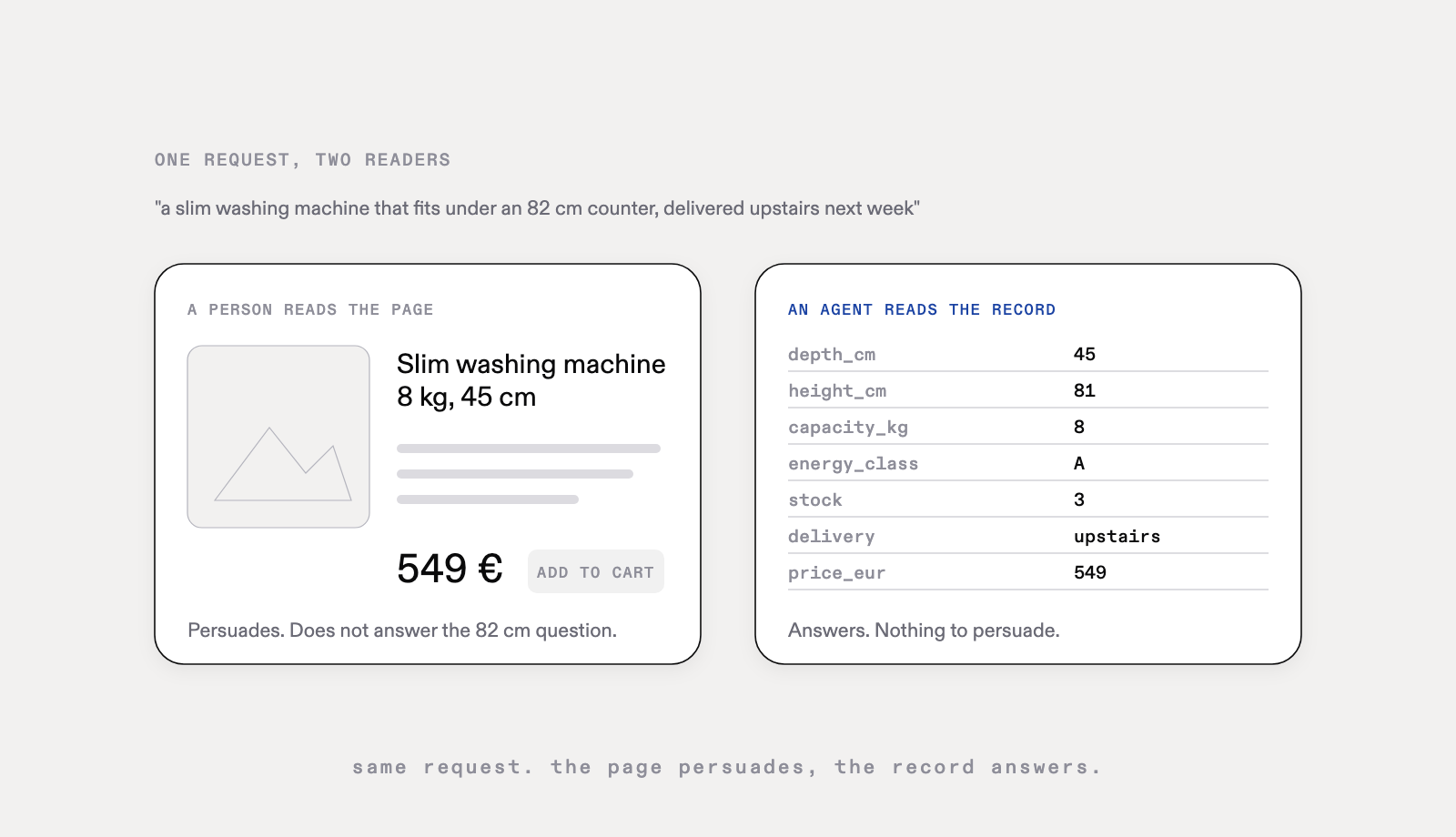
"Compact" tells a customer very little about whether a washing machine will fit. They need its depth in centimeters, whether that includes the door, and how much room to leave for hoses.
Those details let the shopper check the fit and give an assistant useful material for an answer or comparison. Writing a longer description won't help if it still leaves out the measurements.
## Agentic commerce: from answering to taking action
Now the customer asks: "Find a washing machine under €600 that fits this space and can arrive next week. Show me the total before I approve."
The assistant has to check the exact model and dimensions, then confirm current price, stock and delivery to that address. If the customer approves, it needs a way to proceed with the order.
That is what the customer delegates in agentic commerce: part of the shopping task, with limits on what the agent can do.
For the washing machine, the description explains why it might suit a small kitchen. The depth field lets a system check the customer's limit, provided the unit and measurement are clear.
*A person reads the page. An agent checks the fields, so a measurement it cannot find is a condition it cannot apply.*
## Two waves of change in ecommerce
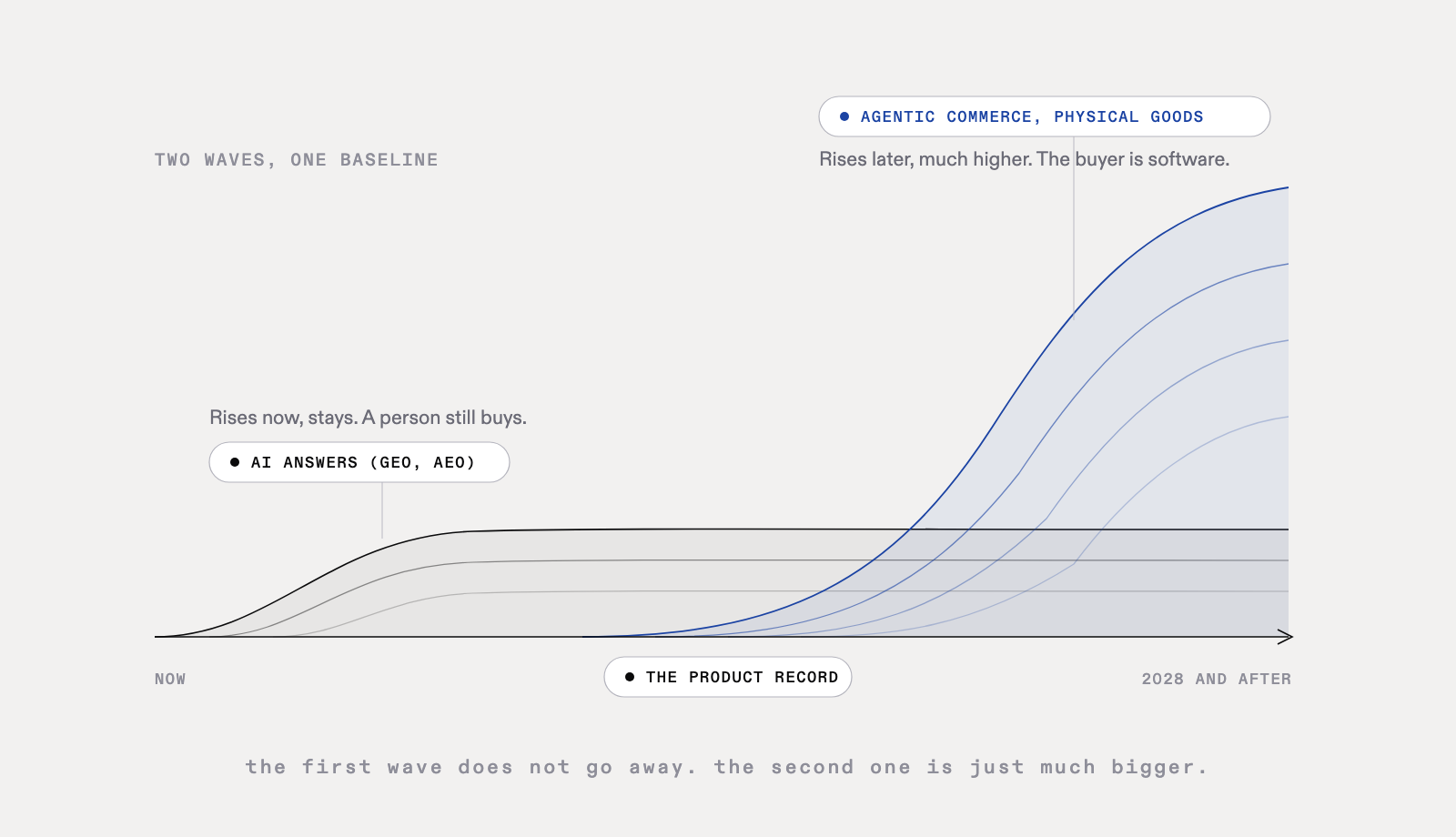
One change concerns how people choose: they can use search results, AI answers and conversational comparisons to research a purchase. SEO, AEO and GEO all belong here.
The other concerns how much of the task they delegate. As an assistant takes on more of the purchase, it needs access to stock, delivery and payment systems. The [Universal Commerce Protocol](https://ucp.dev/) provides specifications and reference implementations for discovery, checkout and later stages of the order.
I wouldn't use those announcements to predict when delegated shopping will become a material share of a retailer's sales. We still need to see how customers use it and how reliably purchases work in each market.
With physical products, a suitable model may be out of stock or unavailable for delivery next week. Shipping could push the total over €600. The agent has to resolve those conditions before placing the order.
*The diagram shows two kinds of change. Its dates and relative heights are illustrative, not adoption data or a forecast.*
*Two changes on the same product record. Dates and heights are illustrative.*
## Where retailers should start: one category, real buying questions
Choose a category your team knows well and write down ten questions that affect the purchase. For washing machines, start with fit, capacity and installation.
Follow each question through the product record, the page and the feed or search tool. Check where the information disappears or changes meaning. Does "depth" include the door in every system?
Test each part of the purchase:
- For discovery, check that search engines can reach the page and that it addresses relevant searches. Follow queries, clicks and conversions.
- For answers, ask a fixed set of buying questions. Check accuracy and the sources cited, then repeat the tests. One favorable AI response is weak evidence.
- For actions, test whether the shopping flow respects the customer's constraints, checks current price and delivery, and completes the steps the customer allowed. Record where it fails.
I would do this before commissioning another batch of AI-written descriptions. Follow one buying question through the store, find the first missing or unreliable fact, and give someone responsibility for fixing it.
## Author
## Questions
### What is the difference between SEO, AEO and GEO?
SEO helps people find your pages through search. AEO makes your content useful as a direct answer. GEO focuses on whether AI-generated answers include your content or products. The work overlaps, but a ranking, a citation and a visit measure different things.
### Does GEO replace SEO?
No. Google says established SEO practices still apply to AI Overviews and AI Mode. Pages still need to be accessible, indexed and useful.
### Is AEO the same as GEO?
The terms overlap. AEO focuses on answering a question directly; GEO focuses on visibility in a generated response. Accurate specifications and clear explanations help with both.
### What is agentic commerce?
A customer delegates shopping tasks to an AI agent, such as finding suitable products, checking delivery or preparing an order. The agent acts within the permissions the customer gives it. Your ecommerce has an AI agent score explains the practical readiness checks.
### Is GEO the same as agentic commerce?
No. GEO concerns what appears in an AI answer. Agentic commerce also involves taking action. An assistant can cite a product page even when it has no way to check delivery or proceed with the order.
### Does agentic ecommerce require a separate catalog?
Use one shared source of product facts, then map it to each integration's format. Price and stock need different update schedules from dimensions. Our ChatGPT product feed guide shows why reusing a Google Shopping feed still requires checking supported fields and eligibility settings.
## Entities
- Claude Commerce Agents: the agent got easy to build. The catalog decides what it can enforce. · mentions
- Your ecommerce has an AI agent score. · mentions
- ChatGPT product feed: nine required fields, and the optional ones that decide what gets surfaced · mentions
## Sources
---
Canonical: https://commerceclarity.com/blog/geo-vs-seo-vs-aeo-agentic-commerce
Every page of this site is available as markdown: append `.md` to its path. Index: /llms.txt
](https://cdn.sanity.io/images/xd4hrbt2/production/f236fed53e340909df5cd10e54e09ddf90fb3a00-3200x2360.png?auto=format)
](https://cdn.sanity.io/images/xd4hrbt2/production/fb04b70e9d47ff4fa8fac50755501755c18d5814-1600x920.png?auto=format)
](https://cdn.sanity.io/images/xd4hrbt2/production/db1c6d994b9eed27c7cbb6ff727f470e1b23ffbc-1600x920.png?auto=format)
](https://cdn.sanity.io/images/xd4hrbt2/production/10b4152624c1a3b106b6ff9ba5a5014b4fe5d95c-1600x1000.jpg?auto=format)