Solutions · Agentic Commerce
Make products readable by shopping agents.
Agents that publish your catalog where autonomous shopping agents can read it and buy from it: OpenAI’s product spec for ChatGPT, Google Merchant with the conversational attributes its AI surfaces consume, and whatever surface comes after them.

The problem
A new buyer, with no eyes
A shopping agent does not browse. It reads a feed, compares structured attributes and completes a purchase, and it never sees the page you designed. Everything built to persuade a person, the photography, the layout, the copy above the fold, is invisible to it.
It is worth naming what this is not. SEO and GEO/AEO both end with a person on your site: they win a click, or a citation that leads to one, and the human browses, compares and checks out. This does not. There is no session, no category page, no basket anyone built. It is a transaction protocol running over an API, and a catalog can be good at bringing people in while being unreadable to it.
What it does read is a specification, and the requirements are somebody else’s. OpenAI publishes a product spec with its own attribute set and its own update cadence. Google wants the classic Shopping feed and, separately, the conversational attributes its AI surfaces consume. Neither one is your PIM’s schema.
This is also the channel where being early is cheap and being late is not. The feed either validates and republishes on cadence or your products are not in the answer, and there is no ranking to slip slowly down: you are in the consideration set, or you are not in it at all.
Common use cases
The jobs on the feed
A few of the ones that run here, and the list grows every time a surface does. Each is a single workflow with its own output and its own numbers. Publish to one surface, or to all of them.
Publishing to the agents
One pipeline, every surface that reads a feed
For Google, both layers run on one pipeline. The classic mapping onto its required attributes outputs a feed that passes validation for Shopping ads and free listings. The conversational attributes are the second layer, the ones its AI surfaces read in order to recommend a product and complete a purchase. For ChatGPT, the same catalog is transformed to OpenAI’s product spec, its attribute set and its update cadence, then validated and republished on that cadence. Both run off the same source record, so the feed that ranks and the feed that gets recommended stay in step. And when a spec moves, which these specs are young enough to keep doing, we maintain the mapping.

Ask the catalog
AgentAnswers carry their sources
The feedback loop
Every correction makes the next run better
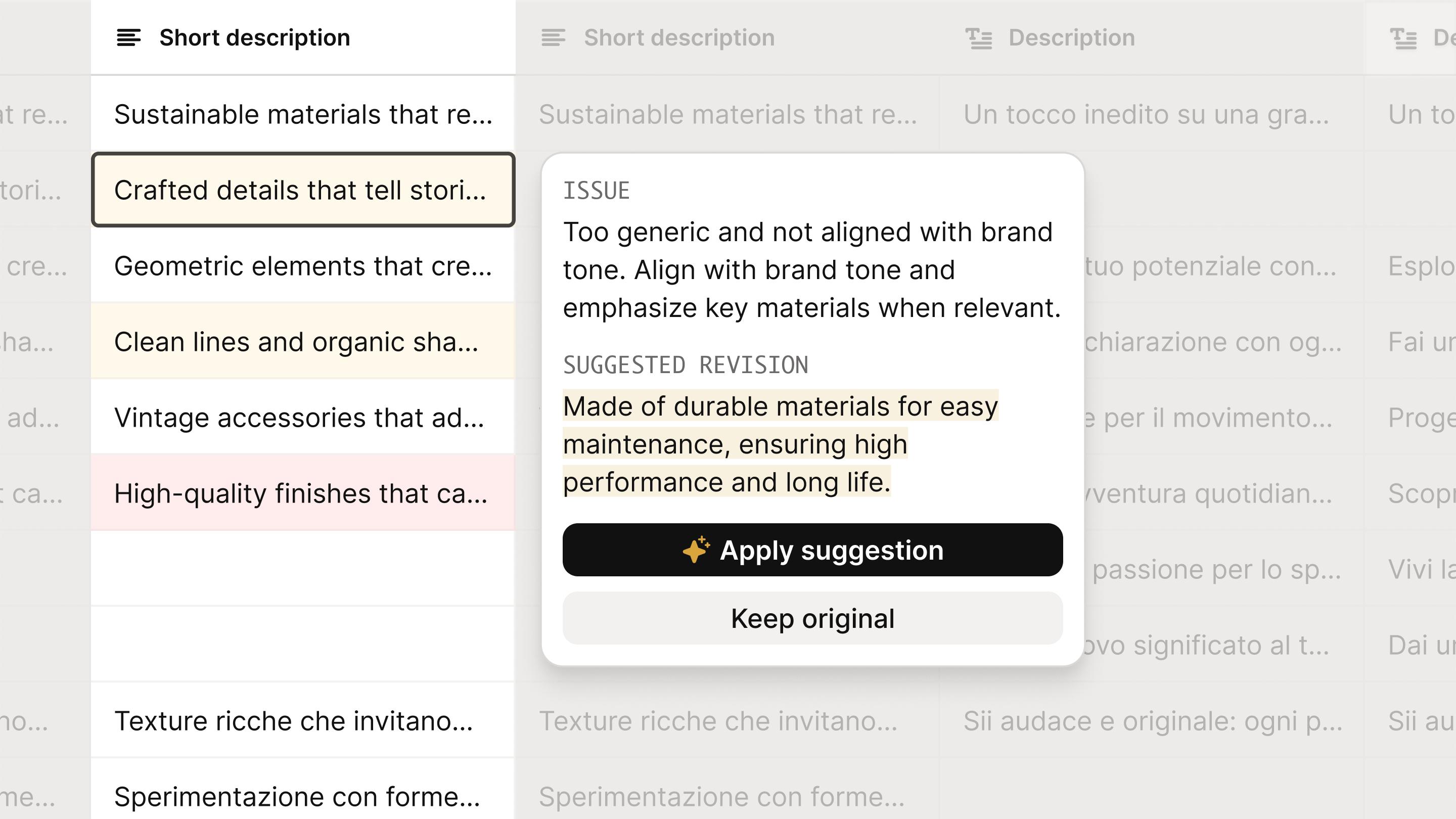
Your team judges the output. A value is right, or it is wrong and gets fixed once. Each verdict changes the next run: the score on your own sample moves, and the agent starts from what the last one learned. So the share of values that need a person keeps falling, measured on your catalog and your rules rather than on an average of everybody else.
How we work
Live on your catalog in weeks, not months
We run all four phases with your team, on the stack you already have, and each one ends with a number you agreed in advance.
- 01
Design
We map how your data comes in and how the result goes back out, then agree the business KPI the agent has to move.
- 02
Implement
We build the agent and test it on a sample of your own catalog, agreed with you. Every change is scored against that sample, so the tuning runs on numbers.
- 03
Prove
Done means the KPI reached target on the full catalog, and you have seen the numbers yourself.
- 04
Evolve
We stay on the account. Your corrections keep improving the agent, the KPI holds where you need it, and the next use case starts from the context this one already built.

Enterprise, on a catalog you cannot break
It runs on the stack you have
It reads your PIM, ERP and DAM through their APIs and writes the result back to them.
Nothing uncertain reaches a channel
Every value is checked against your rules, and anything uncertain goes to review before it reaches a channel.
Your data stays yours
Your own isolated workspace. It is never pooled into shared models, and you can export it at any point.
Every run is logged
Each value carries its source, its run and its score, so you can see why a wrong one went wrong.
Questions
What retailers ask us
What is agentic commerce?
Buying done by software acting for a person, instead of by the person browsing. Read it as a transaction protocol rather than a traffic channel: the agent reads a published product spec, compares, and completes the purchase, and none of that happens on your site.
It changes what a product record is for. A shopper forgives a missing attribute and looks at the photo. An agent comparing options cannot. What is not in the data does not exist, and the product is not in the comparison.
How is agentic commerce different from SEO and GEO/AEO?
SEO and GEO/AEO both end with a person. They win a click, or a citation that leads to one, and the human then browses, compares and checks out on your site.
Agentic commerce ends without a person. The agent never lands on a page. It reads a published product spec over an API, compares what it can read, and completes the purchase inside the conversation. No session, no category page, no basket anyone built.
So the two are not versions of the same work. One improves what a human finds. The other decides whether a machine can transact with you at all, and a catalog can be good at the first while being invisible to the second.
Can you give me an example of agentic commerce?
A person tells an assistant to reorder the dog food they buy, but cheaper, same protein, in the large bag. The assistant does not open a category page. It queries the products it can read, filters on protein source and pack size, checks price and availability, and completes the purchase.
Every step of that runs on attributes. A record that says large bag without the weight, or that never states the protein, drops out of the comparison silently, and nobody at the retailer ever learns it happened.
How is this different from the Google feed we already have?
The Shopping feed exists to win a click that lands on your product page. The conversational layer exists so the agent never needs your product page.
Same catalog underneath, different job. One is built to pass ad validation. The other carries the attribute set the AI surfaces read in order to recommend a product and complete a purchase, and a feed built only for Shopping ads does not carry it.
Is ChatGPT shopping worth a workflow today?
That is your call on timing, and it is a cheap one to take early. It is the same product knowledge mapped onto a published spec, so the work is the mapping and the cadence, not a new content project.
What makes early cheap is the asymmetry. A shopper who did not find you today can come back tomorrow. An agent that could not read you did not include you in a comparison that is already over, and nobody tells you it happened.
What happens when the spec changes?
We maintain the mapping. This is one place where agentic commerce is easier than SEO rather than harder: a ranking algorithm is a black box you infer from results, while these are published, versioned specifications you can read.
The catch is that they are young and they move. That is the argument for running this continuously instead of exporting once and calling it done.
Do we lose control of how we are presented?
Some of it, and it is worth being precise about which. With no page in the flow you lose the levers that lived on the page: photography, layout, badges, where the reviews sit, the copy that persuades.
What is left is the data, and the data is the whole of what the agent reasons on. You control the input. You do not control the comparison, and that is true of any marketplace.
Does this replace SEO?
No, and they do not compete for the same visit. SEO and GEO/AEO bring a person to the site. Agentic commerce is a transaction that completes without one. The overlap is the product knowledge underneath, which is why these areas share it.
Whose data is it?
Yours. The corrections your team makes are what the agents learn from, and both the data and the corrections stay exportable at any point.