# Site search best practices for better product discovery
> FactFinder helps shoppers find and choose products through search, navigation, recommendations and personalization. Accurate product attributes give those capabilities more reliable information to use. CommerceClarity enriches and standardizes the catalog behind discovery. Start with searches that return poor results, check the query and product data, then test the relevant fix.
How FactFinder helps shoppers find the right products, and where better product attributes make search, filters and recommendations more useful.
**Published at:** 2026-10-22T15:26:53Z
**Site search best practices** for relevant results, useful filters and fewer dead ends, with FactFinder and better product data.
Good site search helps shoppers find what they mean, even when they don't use the words in your catalog. They might know a product code, describe a feature or start with a broad idea and narrow it down.
[FactFinder](https://www.fact-finder.com/) helps with each of those tasks. Its product discovery platform combines search and navigation with personalization, recommendations and merchandising. Shoppers can find products in different ways, while your team controls how the range is presented.
Better ecommerce product data helps shoppers make those choices. Search can use clear descriptions to interpret a request, and filters can use consistent attributes to narrow the results. CommerceClarity improves that information so FactFinder has more complete product records to work with.
## Help shoppers search in their own words
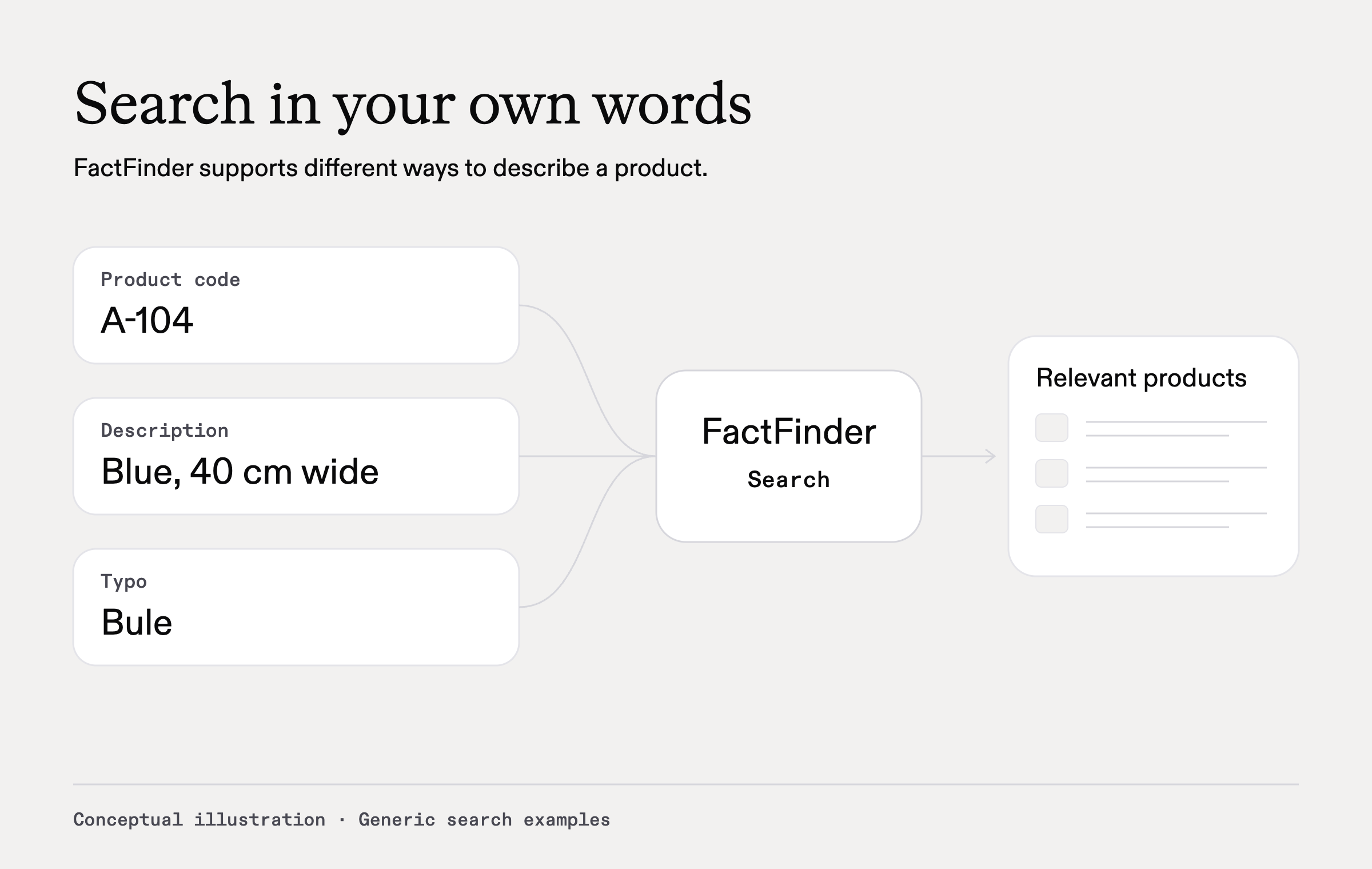
A shopper shouldn't have to guess the exact name of a product to find it.
There is still a difference between understanding a request and having the information needed to answer it. Search may recognize that two phrases mean the same thing. But if a shopper asks for a particular dimension, the product record needs a reliable measurement.
*FactFinder supports product codes, descriptive queries and spelling mistakes. The examples are illustrative.*
## Give shoppers filters they can trust
Filters let people narrow a broad result set to products that meet their requirements. They need consistent product attributes: the structured facts that describe each product, such as color, dimensions and material.
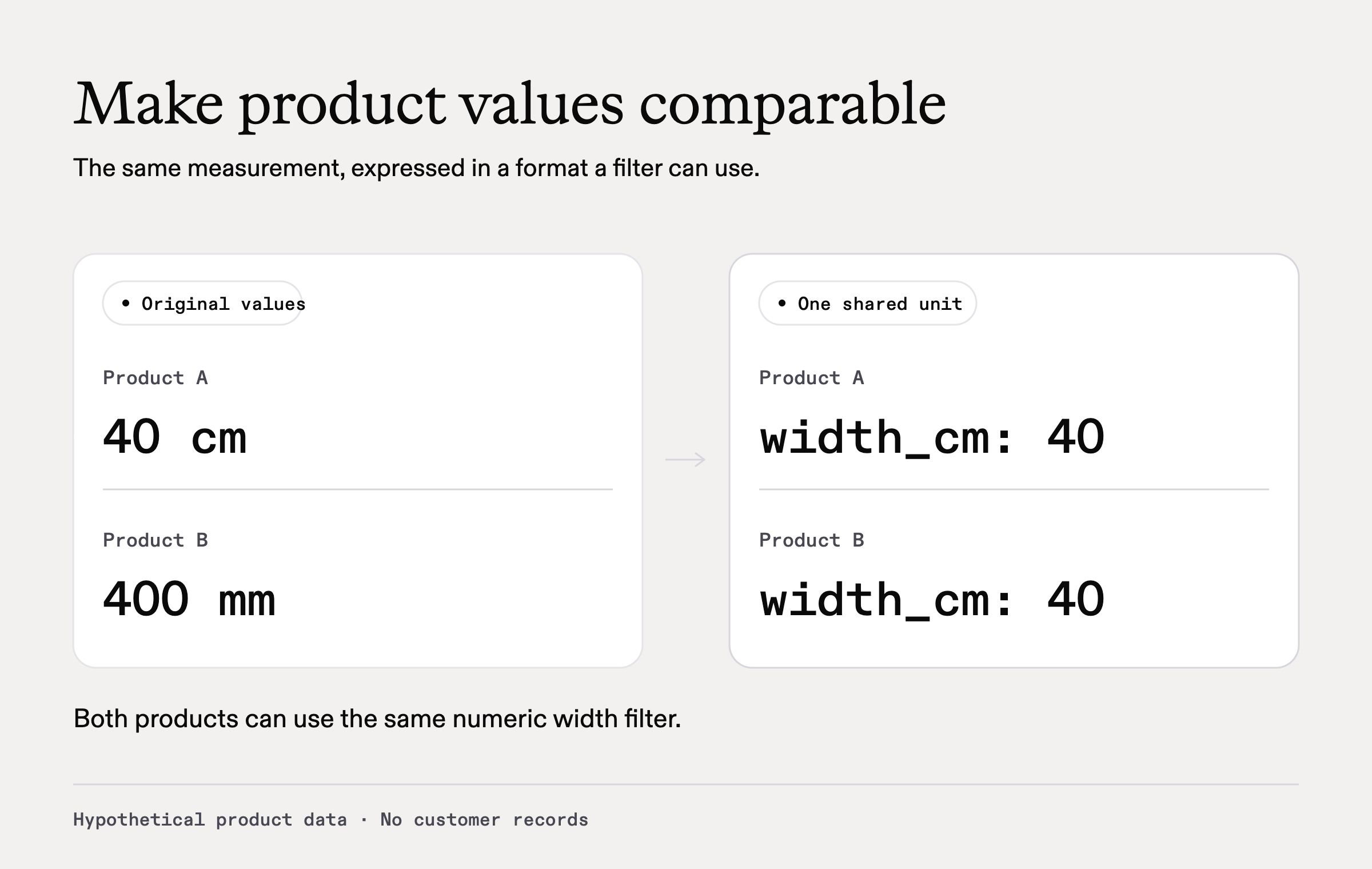
Take a simple, hypothetical example: a width appears as "40 cm" on one product record and "400 mm" on another. Both measurements are correct. To apply the same numeric filter to both products, the values need a common unit.
The same check applies to how other attributes are stored.
The aim is to capture the facts shoppers use to choose. Adding every possible attribute creates more work without necessarily improving discovery. Choose the fields that matter for the products you sell, make the values consistent and check that the search feed includes them.
*Consistent units let the same numeric filter apply across product records. Hypothetical data.*
## Make the next suggestion worth considering
Finding one relevant product is often only the start. A shopper may want an alternative, a related product or a narrower choice.
FactFinder uses browsing and purchasing behavior to inform recommendations and personalization. Its merchandising controls also let your team adjust rankings and give selected products more visibility. These are part of its product discovery platform.
Product information adds context to those decisions. It helps distinguish products that look similar but differ on a feature the shopper cares about. Behavioral signals and catalog data serve different purposes, and both can contribute to a useful recommendation.
Review recommendations against the reason someone is shopping. An alternative should offer a relevant choice, and a suggested companion product should have a supported relationship to the product being viewed.
## Check what went wrong before choosing the fix
A no results page is a reason to investigate. It doesn't tell you on its own whether the issue is the query, the configuration, the feed or the assortment.
Start with searches that matter to your business and inspect what a shopper actually sees. For each one, check:
- Is the product available and included in the search feed?
- Are the attributes in the request present and accurate?
- Can the search configuration use those fields?
- Do the results and filters reflect the shopper's request?
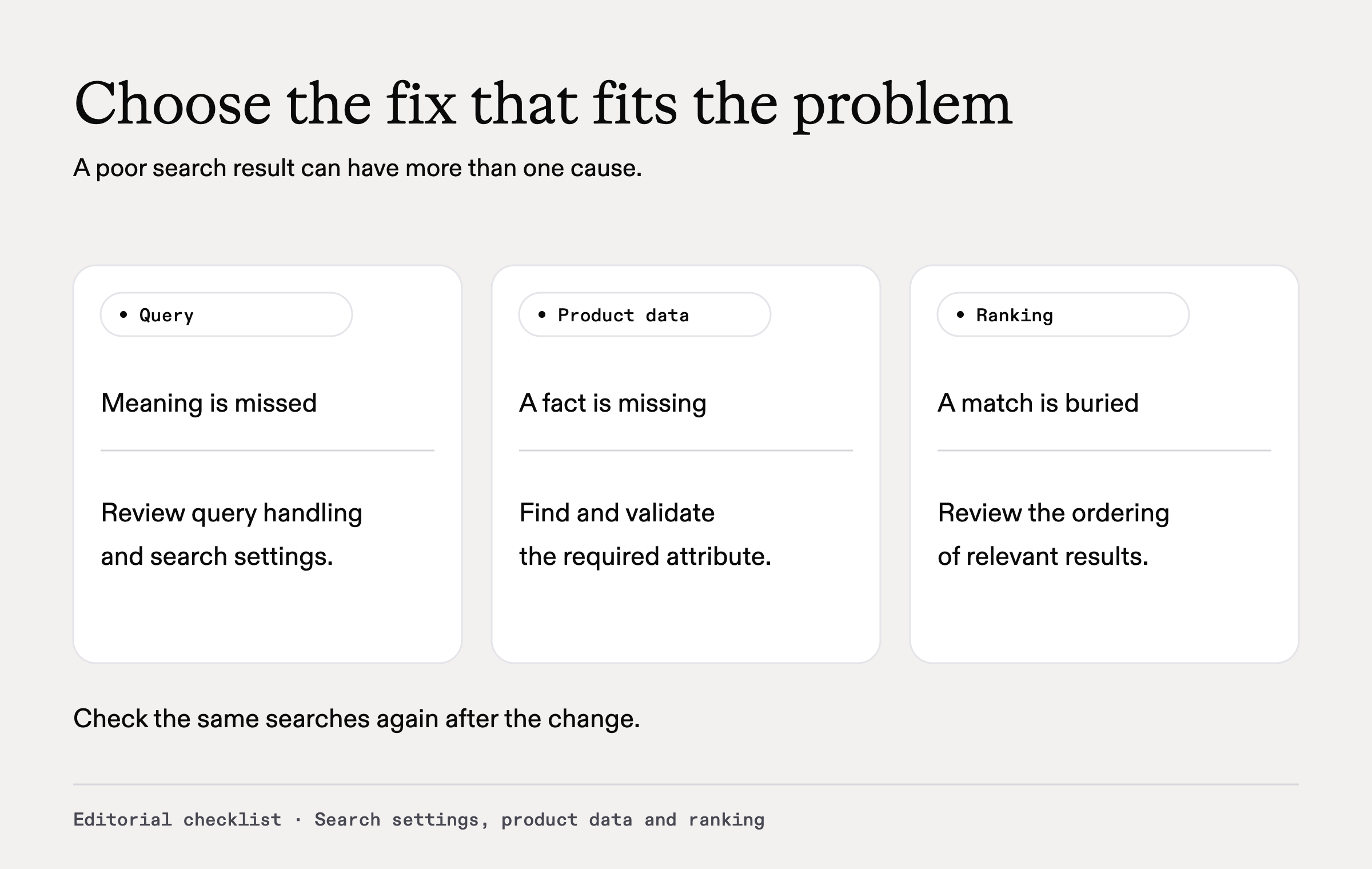
The answer determines the change. A spelling issue may need search configuration. A missing measurement needs product data. A relevant product buried in the results may need a ranking adjustment.
Test the same searches again after the change. Check the relevance of the results as well as whether the empty page has disappeared. Returning more products is not enough if they don't meet the request.
*Search settings, product data and ranking need different checks. Test the same searches after making a change.*
## How CommerceClarity supports FactFinder
FactFinder helps shoppers search, navigate and choose. CommerceClarity improves the product attributes available to it, filling supported gaps and standardizing values across the catalog.
That gives search and filters more complete information to use. The same attributes can also support recommendations, product pages and other channels that read the catalog.
Your existing discovery platform and PIM stay in place. The benefit is better product information within the systems you already use, with the relevant attributes selected for the search experience.
## Author
## Questions
### What are the most useful site search best practices?
Support the ways people search, make filters useful and review searches that return poor results. Check product data alongside search settings: accurate attributes, consistent units and a current feed help the system match products to what shoppers ask for.
### What are product attributes?
Product attributes are structured facts about a product, such as color, dimensions, material and compatibility. They give search and filters specific values to use. The attributes you need depend on what a shopper must know to choose the right product.
### Can better product data fix every site search problem?
No. Search configuration, feed updates, ranking and the products you actually offer also matter. Enrichment addresses missing or inconsistent product information. Diagnose the search before deciding which part needs attention.
### Can synonyms replace product enrichment?
Synonyms help connect different words for the same concept. They don't establish a missing product fact. If a shopper asks for a specific measurement, the catalog still needs an accurate value that search can use.
### Do we need to change our PIM or search platform?
The CommerceClarity and FactFinder partnership is designed to work with the existing catalog systems and discovery platform. CommerceClarity improves the product data those systems use; it does not require replacing the PIM.
### Does product data also matter for AI search for ecommerce?
Yes. Product descriptions and attributes give AI search information to interpret and compare. How a system uses that information varies, so complete data does not guarantee a result or recommendation. It does make more product facts available to search and to AI shopping agents.
## Entities
- Site search · Thing, about
- Product attributes · Thing, about
- CommerceClarity and FactFinder partner on the product data behind product discovery · mentions
## Sources
---
Canonical: https://commerceclarity.com/blog/site-search-best-practices-catalog
Every page of this site is available as markdown: append `.md` to its path. Index: /llms.txt
](https://cdn.sanity.io/images/xd4hrbt2/production/12461bba736a60743e20a94c29f3e0de9b2b84ac-2400x1520.png?auto=format)
](https://cdn.sanity.io/images/xd4hrbt2/production/6df47bb81e8c0df122af1e4e192c6ed6c2f8eabe-2400x1520.png?auto=format)
](https://cdn.sanity.io/images/xd4hrbt2/production/10972d22ea7c091886b84ce2e437d0287eba04ac-2400x1520.png?auto=format)
](https://cdn.sanity.io/images/xd4hrbt2/production/276c8eeeea728ac76263de8f56b488c9cdbe91d3-1600x1000.jpg?auto=format)