Solutions · Search & Discovery
Found on the first try.
Agents working the layer your search engine reads: every product in the right category, and the attributes and synonyms the index needs to reason on. Algolia, FactFinder, Coveo or the search that came with your platform, the relevance ceiling is set by the catalog underneath it.

The problem
The engine can only match what the catalog says
The queries that fail are the ordinary ones. Asked for the worst searches on their own site, a grocery retailer sent back 4: still water, soft bread, yellow peppers, tuna. Plain words, and 3 of them a product name with no attribute attached to it.
What goes wrong is a matching failure rather than a search failure. Ask for red trousers and a product named carrot comes back, because the word matched. Ask for an elegant shirt and you collide with a brand that is literally called Elegant. The engine did exactly what it was told, on the only thing it was given.
Underneath both sits the taxonomy, and it is usually two taxonomies. One retailer handed us their tree and told us which half of it was real: 1,000 live leaf categories against 3,000 counting the disabled legacy ones, plus a set of leaves still alive under a parent that had been switched off. Search filters, SEO landing pages and marketplace acceptance all read that tree, so a category that does not resolve costs you all three at once.
Common use cases
The jobs on discovery
A few of the ones that run here, and the area is not limited to them. Each is a single workflow with its own output and its own numbers, reading the same records the rest of the catalog reads.
Findability
The category, and the words around it
What decides whether a product surfaces sits underneath the query, and that is where the agents work. The category comes first: every product classified at the right depth of your own tree, continuously, with the drift between the tree you designed and the tree you actually use reported back to you. A boundary call stays a category argument rather than a keyword one, so a fixed balcony solar kit is a different product from a portable panel however similar the words look. Products with no valid slot come back as the list of categories your taxonomy is missing. Then the attribute layer the index reads: missing attributes generated, existing ones normalized, and the synonym and variant lists the engine needs, so a search for red trousers returns trousers. Algolia, FactFinder, Coveo or an agentic engine, that layer is the ceiling on all of them.

Relevance lift after attribute fill
The feedback loop
Every correction makes the next run better
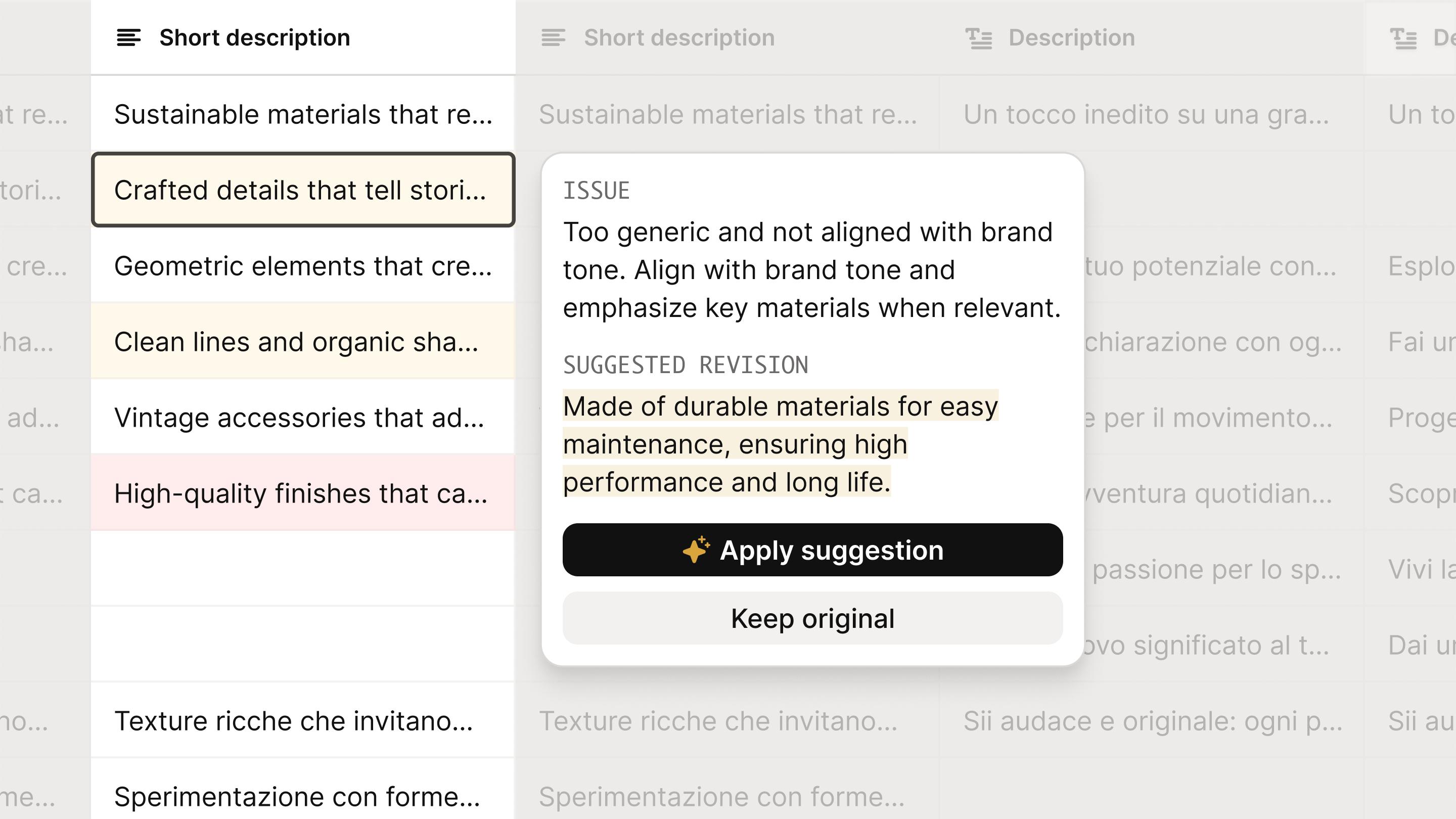
Your team judges the output. A value is right, or it is wrong and gets fixed once. Each verdict changes the next run: the score on your own sample moves, and the agent starts from what the last one learned. So the share of values that need a person keeps falling, measured on your catalog and your rules rather than on an average of everybody else.
How we work
Live on your catalog in weeks, not months
We run all four phases with your team, on the stack you already have, and each one ends with a number you agreed in advance.
- 01
Design
We map how your data comes in and how the result goes back out, then agree the business KPI the agent has to move.
- 02
Implement
We build the agent and test it on a sample of your own catalog, agreed with you. Every change is scored against that sample, so the tuning runs on numbers.
- 03
Prove
Done means the KPI reached target on the full catalog, and you have seen the numbers yourself.
- 04
Evolve
We stay on the account. Your corrections keep improving the agent, the KPI holds where you need it, and the next use case starts from the context this one already built.

Enterprise, on a catalog you cannot break
It runs on the stack you have
It reads your PIM, ERP and DAM through their APIs and writes the result back to them.
Nothing uncertain reaches a channel
Every value is checked against your rules, and anything uncertain goes to review before it reaches a channel.
Your data stays yours
Your own isolated workspace. It is never pooled into shared models, and you can export it at any point.
Every run is logged
Each value carries its source, its run and its score, so you can see why a wrong one went wrong.
Questions
What retailers ask us
What is ecommerce site search?
The search box on your own store, and the product data it reads. Most search failures get blamed on the engine and are not the engine. It returns nothing because the product carries no colour, no material, or a category nobody would search for. We do not replace the search engine. We fix what it has to read.
Do you replace our search engine?
No. We work on the layer it indexes. Algolia, FactFinder, Coveo or the search that came with your platform: the agent improves the attributes, synonyms and categories the engine reasons on, and the engine stays where it is.
How do you know the classification is right?
It is measured, not asserted. Correctness is scored against an evaluation set your own experts sign off, and reported as a percentage with the errors listed product by product.
What happens to products with no valid category?
They are surfaced, not forced. The run hands back the categories your taxonomy is missing as a decision for you to take, kept separate from the products that were genuinely put in the wrong place.
Our taxonomy keeps changing. Does that break it?
No, it is the normal condition. Classification runs against the tree that is live, and when the tree moves the evaluation set and the agreed bar get re-pinned rather than assumed to carry over.
Who decides the edge cases?
You do. Where a product type belongs is a merchandising decision, so the boundary you draw is encoded as an explicit rule.
Whose data is it?
Yours. The corrections your team makes are what the agents learn from, and both the data and the corrections stay exportable at any point.