# Your ecommerce has an AI agent score.
> Chrome's Lighthouse has an experimental Agentic Browsing category with four areas: accessibility, layout stability, an llms.txt check and WebMCP integration. CommerceClarity implemented WebMCP on its own site and recorded 4 of 4. Google Search says llms.txt does not affect ranking; WebMCP is a W3C Community Group draft in a Chrome origin trial. For an enterprise retailer: run the test, pilot one action, keep llms.txt to key pages, and prepare catalog data and processes for agentic commerce.
We ran Lighthouse’s experimental Agentic Browsing checks on our own site and read what they measure. What a retailer should do with the result, what to try with WebMCP and llms.txt, and where the real preparation for agentic commerce happens: the catalog.
**Published at:** 2026-09-14T12:00:00Z
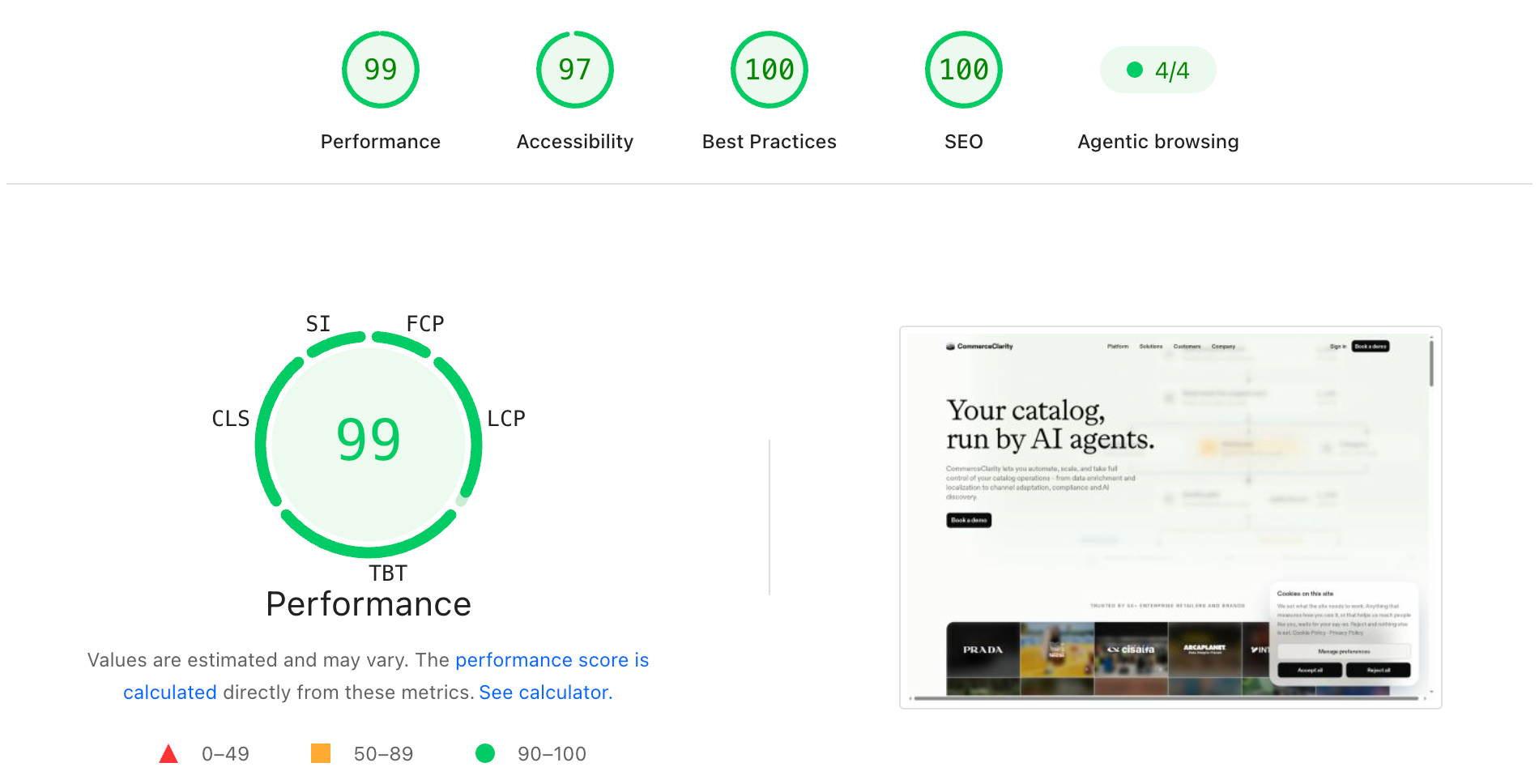
We implemented WebMCP on CommerceClarity’s website and recorded a 4/4 result in Lighthouse’s experimental Agentic Browsing category. I wanted to understand what the checks could tell us before recommending any of this to a retailer.
They tell you something useful about how an agent can interact with a page. They don’t tell you whether it can choose the right product, trust its specifications or make a purchase your business can actually fulfill.
*Our own result, recorded on 14 September 2026 with the experimental category enabled. A pass ratio, not a score out of 100.*
## What Google’s agentic browsing checks actually measure
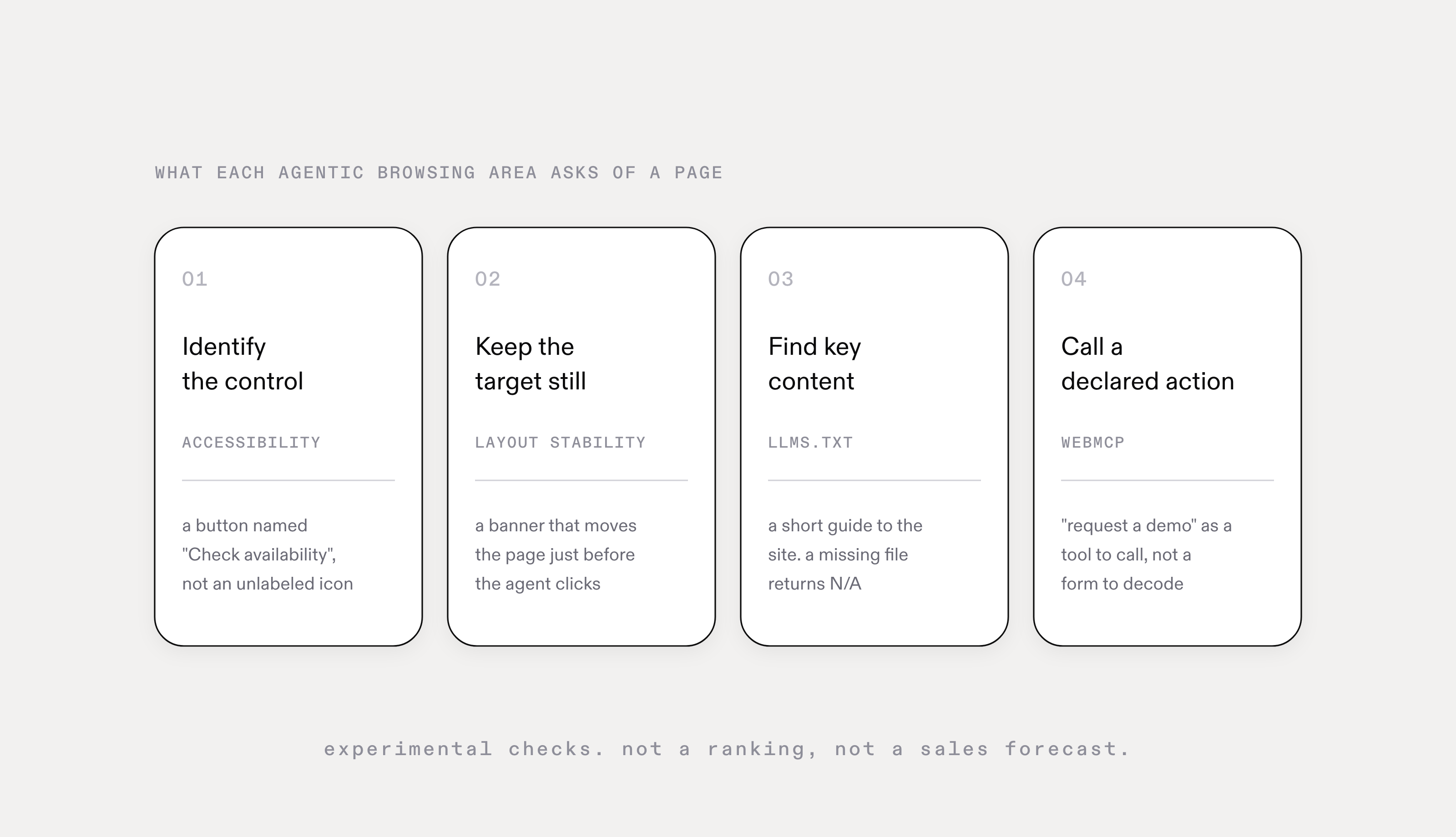
**1. Accessibility: can the agent identify what’s on the page?** Buttons, inputs and links need meaningful names and roles. A button labeled “Check availability” gives the agent more to work with than an unlabeled icon.
**2. Layout stability: does the target stay where it was?** If a banner pushes the page down just before a click, the agent can hit the wrong control. Lighthouse uses Cumulative Layout Shift to assess this.
I would ask your team to test the homepage, a product page and a shipping or returns page. Try [PageSpeed Insights](https://pagespeed.web.dev/); if the experimental category isn’t available there, use the supported Lighthouse setup described by Google. The documentation requires Chrome 150 or later, with origin-trial registration for the WebMCP audits.
Keep the individual results, including N/A, alongside the page URL and test environment. A fraction without that context is easy to overread.
*Experimental checks. Not a ranking, and not a sales forecast.*
## What is WebMCP, and why did we implement it?
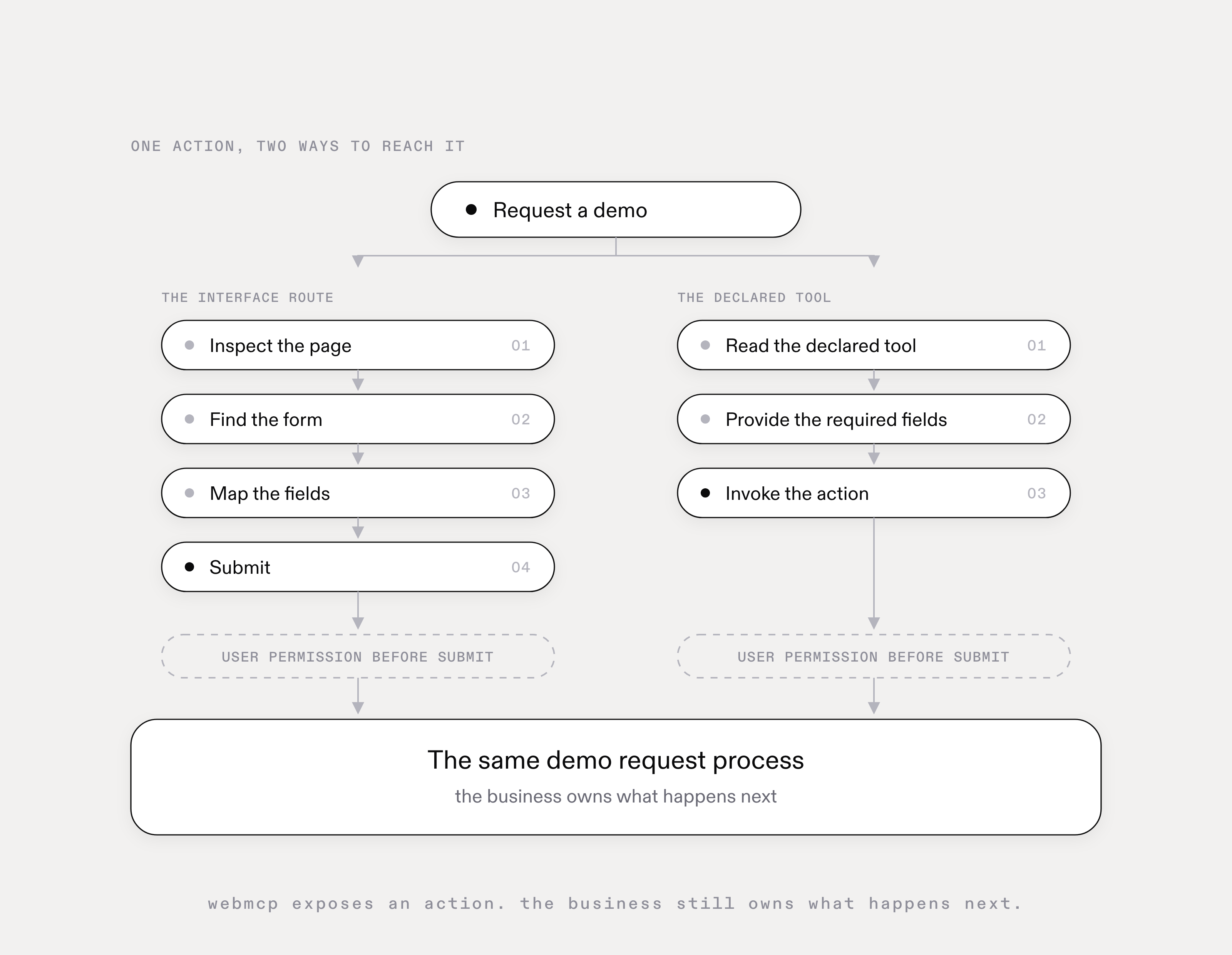
An agent using a website can inspect the interface, find a control and interact with it. That can work, but a complicated form leaves plenty of room for mistakes.
WebMCP gives the agent another route. The website declares an action, explains what it does and specifies the information it needs. Instead of working out how to complete a booking form, the agent can use a tool designed for that booking. The current draft supports tools implemented in the page’s JavaScript. [WebMCP specification](https://webmachinelearning.github.io/webmcp/)
MCP, short for Model Context Protocol, is the broader approach to connecting AI applications with tools and data. WebMCP brings a related tool interface into the browser. It does not mean creating an MCP server for every product.
On our site, we implemented tools to read page content, discover the site’s pages and request a demo. We wanted to learn what happens when an agent can use our existing content and actions directly. CommerceClarity is an AI-native company; testing this on our own website is part of how we form an opinion before taking it to customers.
Google is actively developing and testing WebMCP in Chrome. The specification also has editors from Microsoft. But the document is still a W3C Community Group draft, explicitly **not a W3C Standard**. Chrome’s [origin trial](https://developer.chrome.com/blog/ai-webmcp-origin-trial) is a time-limited experiment intended to gather feedback. Official documentation is evidence of serious work, not a promise that today’s API will remain unchanged.
*WebMCP exposes an action. The business still owns what happens next.*
## For physical-goods retail, I would start with a small pilot
A booking, appointment or quote request is where I would look first. It has a clear task, a defined set of inputs and an outcome you can check.
Retail has useful candidates too: checking store availability, configuring a product or adding the right variant to a cart. I would not rule those out. I would ask the team to demonstrate that a declared tool makes one of them more reliable than the existing flow.
What I would avoid today is turning WebMCP adoption into a broad enterprise program just to improve the report.
For physical goods, the action depends on information outside the page: current inventory, regional prices, variant relationships, delivery eligibility and returns conditions. A tool can expose “check availability.” It cannot make the underlying inventory reliable. You still need permissions, confirmation for consequential actions, failure handling and someone responsible when the result is wrong.
My recommendation is to choose one useful action, test it with a supported agent and measure completion, errors and recovery. Expand when the evidence warrants it.
## What is an llms.txt file, and should your ecommerce have one?
An llms.txt file gives agents a concise introduction to a site and links to useful content. Markdown versions of those pages are a related choice. A full-text bundle, often called llms-full.txt, is another. You do not have to produce a Markdown copy of every product page to maintain a useful index.
For an established retailer with a capable digital team, I would still do a limited version.
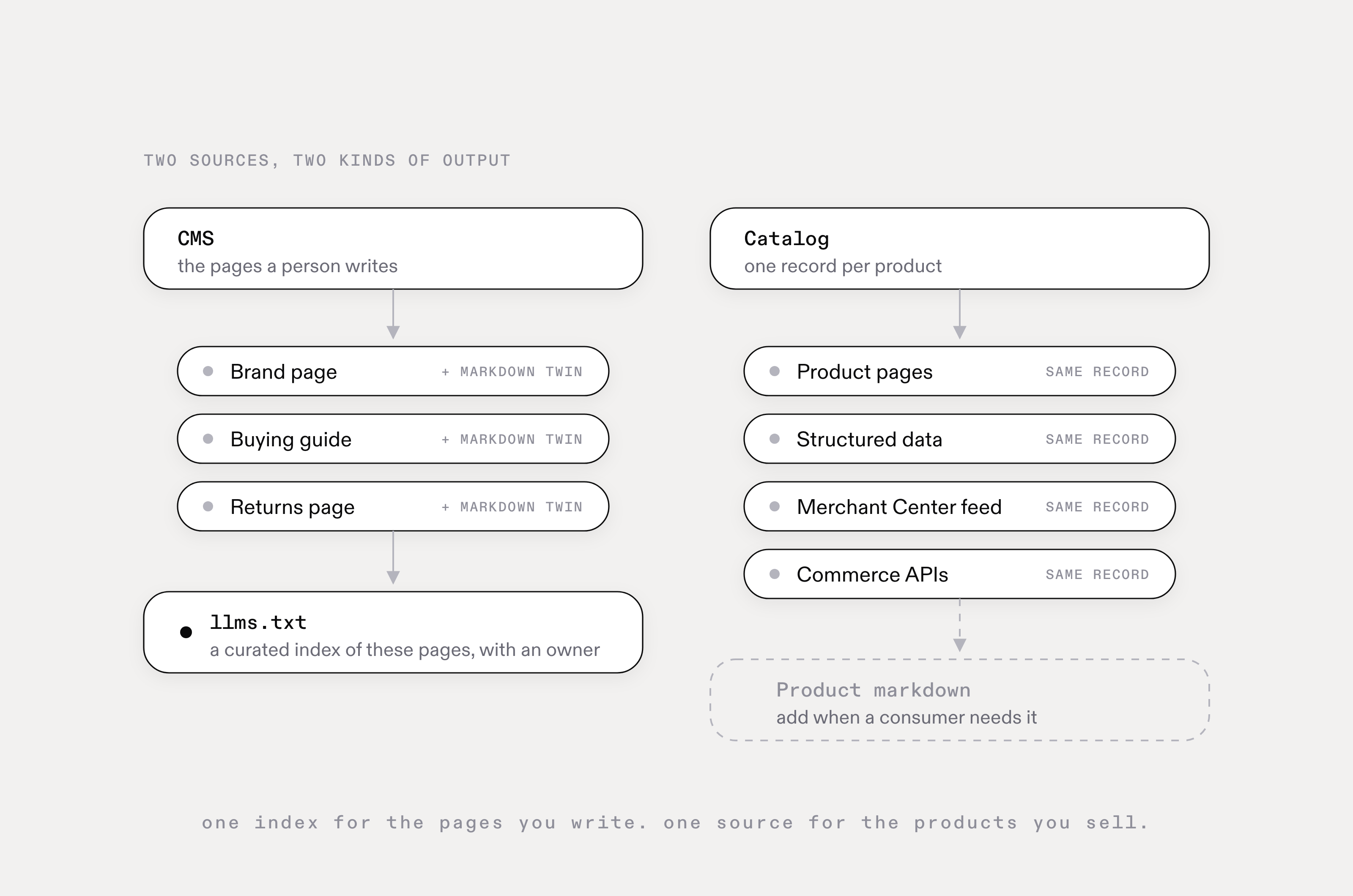
Start with the pages that explain the business and help a buyer make a decision: the brand story, important category introductions, buying guides, delivery, returns and warranty information. Where practical, offer clean Markdown versions from the same content source. Give the file an owner and check its links when those pages change.
I would not make Markdown versions of all 70,000 product pages the default next step. The cost depends on your architecture: automatic output from the same source is very different from a separately maintained copy. Either way, you need to keep prices, availability and product claims current wherever they appear. I would want evidence that an intended consumer uses that extra format before taking on the work.
### An llms.txt example for a retailer
A small index might introduce the business and link to a buying guide and a returns policy. This illustrative llms.txt example uses placeholder URLs; replace them with working pages you maintain.
`# Example Retailer`
`> Home appliances, with buying guides and delivery information.`
`## Buying guides`
`## Customer information`
### What should an llms.txt checker check?
Check that the file follows the format your intended consumer supports, that its links resolve and that the linked content is current. If you provide an llms-full.txt bundle, check that output too. A file returning HTTP 200 can still contain broken links or outdated information. Lighthouse’s retrieval check does not replace those checks.
*One index for the pages you write. One source for the products you sell.*
## Enterprise agentic commerce starts with the catalog and its processes
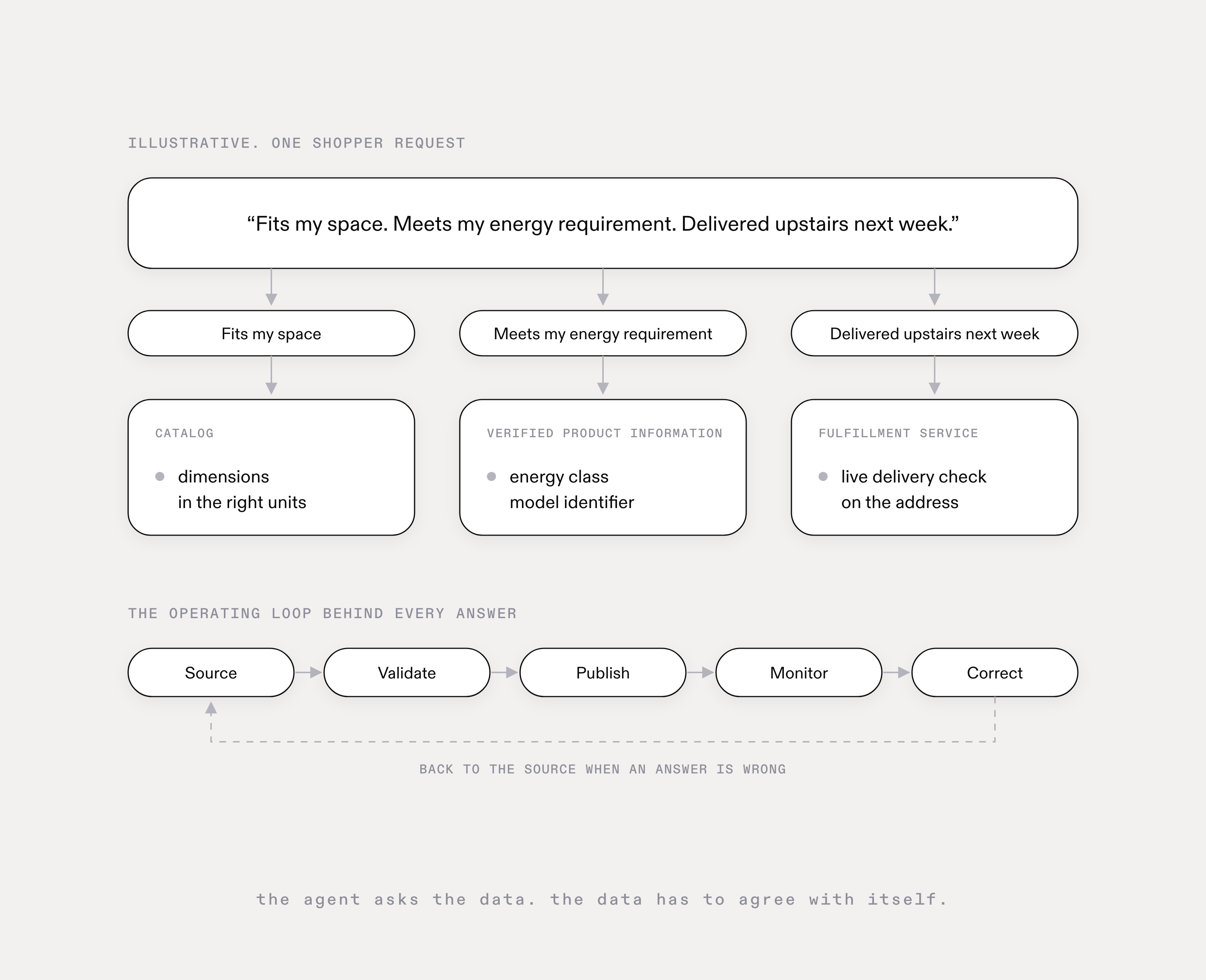
Imagine a shopper asking an agent for a washing machine that fits a particular space, meets an energy requirement and can be delivered upstairs next week.
The answer needs more than a readable page. It needs dimensions with the right units, a reliable model identifier, accurate product information and a live delivery service that can check the address. Some of that belongs in the catalog. Some belongs in inventory, pricing and fulfillment systems. The systems have to agree on which product they mean.
That is the sense in which **the catalog is the new storefront**. Your product needs to be represented accurately enough to enter the comparison, meet the shopper’s constraints and support a purchase. The FAQ below spells out the phrase; the operational consequence is that catalog work now serves both people and software making choices for them.
For an enterprise retailer, I would build that preparation into the existing catalog operation:
For physical products, preparation also includes applicable product safety and consumer-information obligations. Selling through an agent does not remove the need to supply accurate product, price and delivery information. Your teams need to determine the requirements for each market and category and include them in [catalog compliance and quality checks](https://commerceclarity.com/solutions/compliance-quality). [EU product safety guidance](https://europa.eu/youreurope/citizens/consumers/shopping/product-safety/index_en.htm), [EU consumer information guidance](https://europa.eu/youreurope/citizens/consumers/shopping/contract-information/index_en.htm)
This work supports internal agents as well. If you want agents to classify products, enrich attributes or prepare channel content, you need to define the inputs, rules, evaluation and exception handling. Connecting an agent to an inconsistent catalog simply gives it an inconsistent catalog to work with.
That is the work we do through [catalog foundation](https://commerceclarity.com/solutions/catalog-foundation): bring raw product information into complete, validated attributes, then run the processes that keep them useful across channels. Our article [Meet the Retail Engineer](https://commerceclarity.com/blog/meet-the-retail-engineer) explains who owns that work from the initial business question through deployment and ongoing evaluation. It gives enterprise agentic commerce something dependable to run on.
*Illustrative. Each condition in the request has an owner, and an operating loop keeps the answer right.*
## Start before it becomes a material share of sales
I expect agentic commerce to become a substantial channel. I would not attach a guaranteed percentage and date to that expectation.
The preparation case does not depend on hitting that exact number. If this becomes material in two, three or four years, how long will it take your organization to get the data and operations ready?
Think of a retailer in 1994 deciding when to take ecommerce seriously. Publishing a website was only one part of learning to sell through a new channel. The comparison is about preparation time, not a claim that the adoption curves will match.
An enterprise can run a useful pilot now while spending longer fixing the systems and ownership that wider adoption will require. Better catalog data also improves the channels you already operate.
Run the Lighthouse test. Then take one important category and ask whether the information behind it can answer the questions your customers actually ask.
## Author
## Questions
### What is agentic commerce?
Agentic commerce is shopping in which an AI agent takes on tasks for a customer, such as finding products, comparing options or carrying out an authorized purchase. Different systems support different levels of autonomy; an assistant recommending products is not necessarily completing transactions.
### What is enterprise agentic commerce?
Preparing a large retail business to support those interactions across its catalog, markets, channels and operating systems. Alongside product discovery, it requires reliable data, integrations, permissions, quality checks and clear responsibility for failures. It is an operating challenge, not the name of a separate technical standard.
### What does “the catalog is the new storefront” mean?
An agent can compare products by querying catalog data through an API or feed, instead of following the same visual journey as a person. It might ask which model fits a space, whether a variant exists or what material a product contains. Your attributes determine how well the product can answer those questions. Agents can also browse pages, and the visual storefront still matters for people. The phrase describes the growing role of product data in discovery and selection.
### Is WebMCP an official Google standard?
No. Google supports its development and testing, but WebMCP remains a W3C Community Group draft, not a W3C Standard. Chrome’s experimental implementation and Lighthouse checks do not establish universal browser or agent support.
### What is an llms.txt file?
A short Markdown guide to a website, with context and links to selected content. It helps a compatible agent find information without first exploring the whole site. It remains a proposal, and its usefulness depends on whether the agent retrieves and uses it.
### Does llms.txt help SEO?
No. Google says llms.txt does not affect visibility or ranking in Google Search. Its inclusion in Lighthouse’s experimental agentic browsing checks serves a different purpose and does not make it a ranking factor.
### What is the Universal Commerce Protocol?
The Universal Commerce Protocol, or UCP, is an open protocol for commerce interactions such as checkout. A merchant can publish a profile at /.well-known/ucp to describe supported capabilities and endpoints. That profile does not replace or validate the product catalog.
### Should I create Markdown versions of every product page?
I would not make that the default. Start with key brand and editorial pages where the publishing cost is small. Add product Markdown when there is a consumer and a maintenance model that justify it. Product pages, feeds, structured data and APIs should remain aligned to the same underlying information.
### Does passing Lighthouse mean my store is ready for AI agents?
It means the tested page passed the applicable checks in that environment. It does not validate product claims, stock accuracy, fulfillment or an entire purchase journey. Use the report to find technical issues, then test real tasks separately.
## Entities
- Claude Commerce Agents: the agent got easy to build. The catalog decides what it can enforce. · mentions
- Meet the Retail Engineer · mentions
## Sources
---
Canonical: https://commerceclarity.com/blog/llms-txt-webmcp-ecommerce
Every page of this site is available as markdown: append `.md` to its path. Index: /llms.txt
](https://cdn.sanity.io/images/xd4hrbt2/production/63d77bce32d93359453f0f73d901bfcbed001b26-1900x968.png?auto=format)
](https://cdn.sanity.io/images/xd4hrbt2/production/3131bed807169fe22bf4f21929357787534efeb4-3200x1840.png?auto=format)
](https://cdn.sanity.io/images/xd4hrbt2/production/769b54b9c9b5592e038944051a36e51a204aa4ef-3200x2480.png?auto=format)
](https://cdn.sanity.io/images/xd4hrbt2/production/0e96d04fd5ef4bae9435ffa6c120540e0b760b27-3200x2120.png?auto=format)
](https://cdn.sanity.io/images/xd4hrbt2/production/03fd35725c99383033cd818fa6afa9b1d445b2d9-3200x2600.png?auto=format)
](https://cdn.sanity.io/images/xd4hrbt2/production/aea4b0c8a2a9320d15c97191a41a6f9edb5fc5a9-1600x1000.jpg?auto=format)