
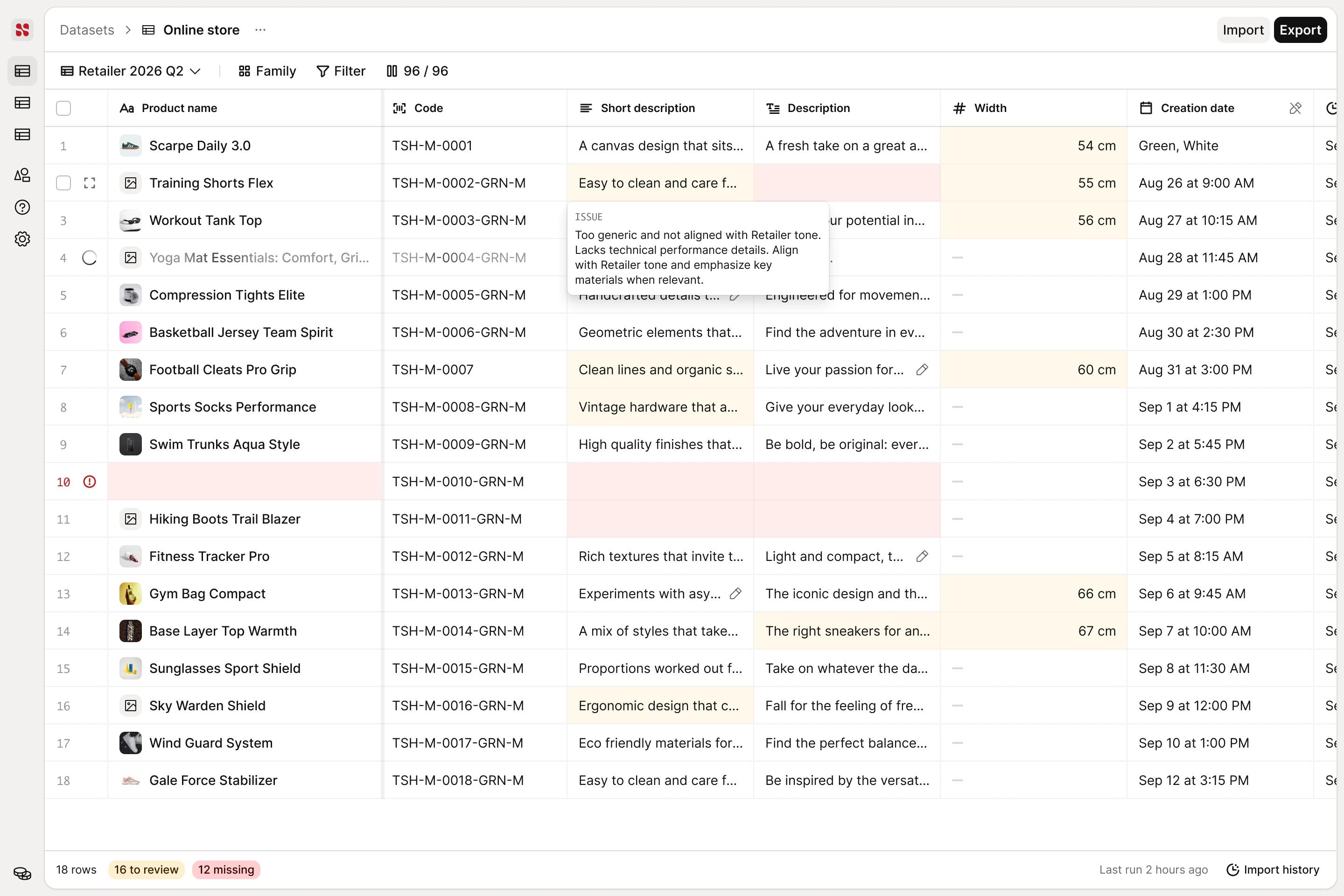
North Star rules
Every agent is held to the same standard, and that standard is your rules.
Your rules - from brand voice to category and compliance requirements - become instructions every agent follows automatically.
- Your rules, applied automatically.
- Brand voice, content guidelines, category requirements and compliance rules - encoded once and applied every time.
- One standard, everywhere.
- Set once, applied across every SKU, market, and channel, scoped per market and category where needed.

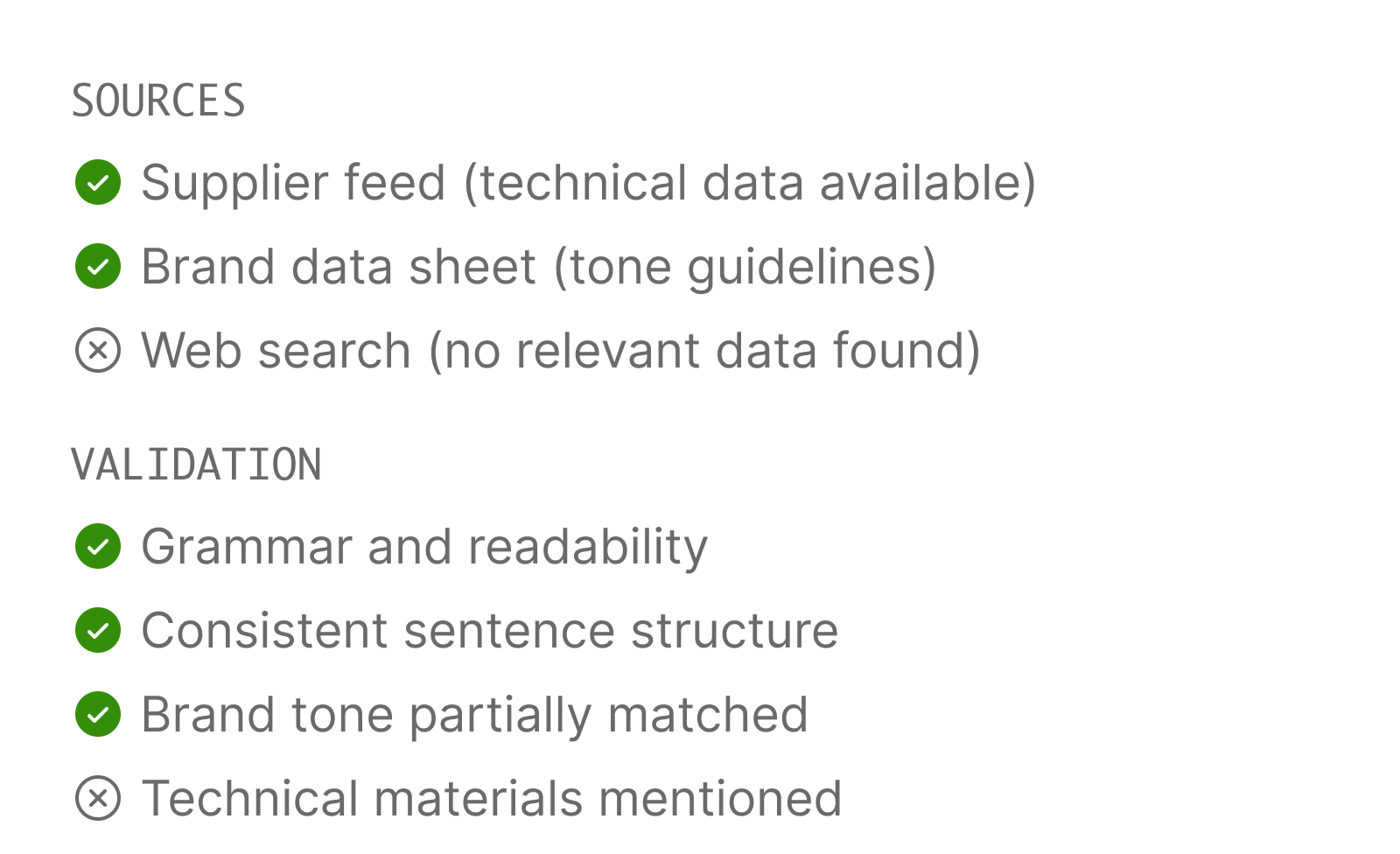
Automated checks, human judgment
Your team stays in control, without checking every product.
Every output is scored against your rules before it moves. What the system is not sure about is flagged and waits for a person; what passes with confidence publishes.
- Every output scored before it moves.
- Format and schema checks catch the hard errors, an AI grader reads the rest against your rules, and the scores track quality across the whole catalog.
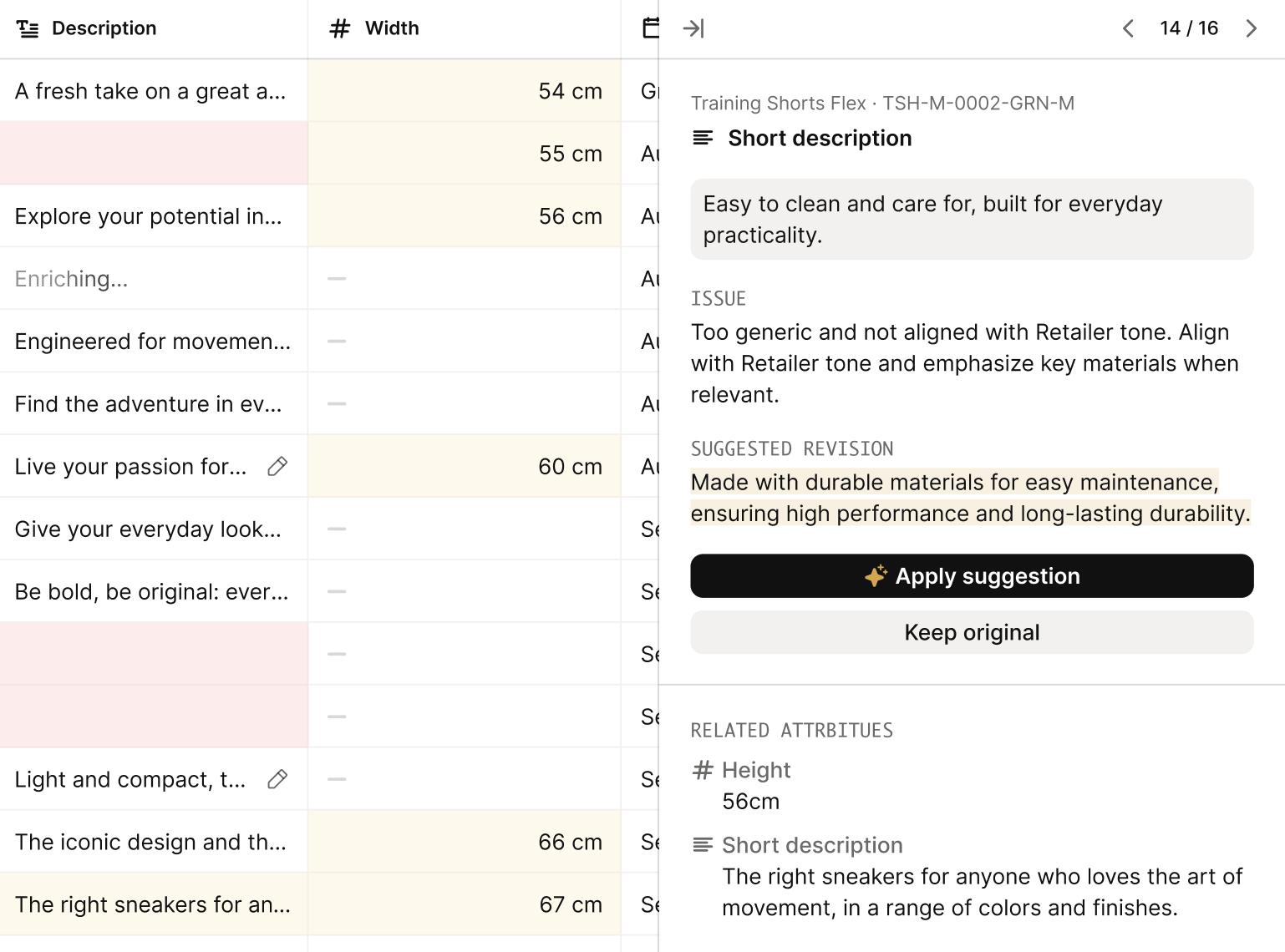
- Review only what needs your attention.
- Issues are flagged automatically, so your team spends its judgment on the exceptions instead of re-reading the catalog.

What control looks like
Measured, not assumed
- 100%
- of outputs checked against your rules
- Continuous
- quality tracking, not a one-off
- 0
- unmanaged outputs reach your catalog
Why it matters
Control every output. Build trust, stay compliant, and publish with confidence.
- 01
Trust
Every output is checked against your standards before it ships, so your team can trust AI with more of the work.
- 02
Compliance
Regulated claims and category rules are applied automatically, with a full audit trail behind every decision.
- 03
A compounding advantage
Your team's decisions become part of the standard, so quality improves over time.
Questions
Questions we get asked
What counts as a rule?
Anything you would send a product page back for. How you sound, the claims you refuse, what a category is required to state, the format a value has to take, the target a market is held to. You write it down once, and from then on every agent answers to it.
How do you test quality?
In layers, cheapest test first. Format and schema are settled outright, because a malformed value needs no judgment. What is left goes to a grader that reads it against your own rubric, and those scores roll up across the catalog so no category hides behind an average. Where the two disagree, a person decides, and that decision becomes the reference. Nothing moves without a score.
Do you check every output?
Yes. Every output runs through the quality checks against your rules, continuously, not sampled once at launch.
How do we stay in control of the output?
Every output is checked against your rules before it can publish. What the system is not sure about is flagged and waits for a person. What passes with confidence goes out, so your team is not re-reading a catalog to find the few values that need a decision.