Solutions · Compliance & Quality
Product compliance checked before you publish, not after.
One rulebook, and agents to run it: auditing the whole catalog against it to tell you where you stand, watching the live one to raise a defect as it appears. Your editorial rules and the regulation you do not get to negotiate, checked with the same instrument.

The problem
Nobody reads a hundred thousand products
Quality in a catalog is a sampling problem rather than a review step. A person can check a hundred products properly. The rules that matter, brand tone, a mandatory statement, a claim you are not allowed to make, apply to all of them, and the ones nobody checked are the ones that reach a customer.
And the rulebook is two rulebooks. Yours: tone of voice, glossary, translation rules, HTML and SEO standards, what the brand may and may not say. And the one you were given: anti-greenwashing wording, category regulation, the Digital Product Passport arriving for whole categories at once. Most retailers have the second written down and not the first, which is its own finding.
The catalog also does not hold still once it is published. A marketplace quietly stops showing a product. A third party overwrites your image. An attribute drifts away from the system of record, a feed breaks and nothing says so. Each of those is found by a customer or by a buyer, unless something is watching for it.
Common use cases
The jobs on quality
A few of the ones that run here. Some run on cadence across the whole catalog, some continuously on the live one, and each has its own output and its own numbers.
Keeping the catalog clean
One rulebook, run on cadence and watched live
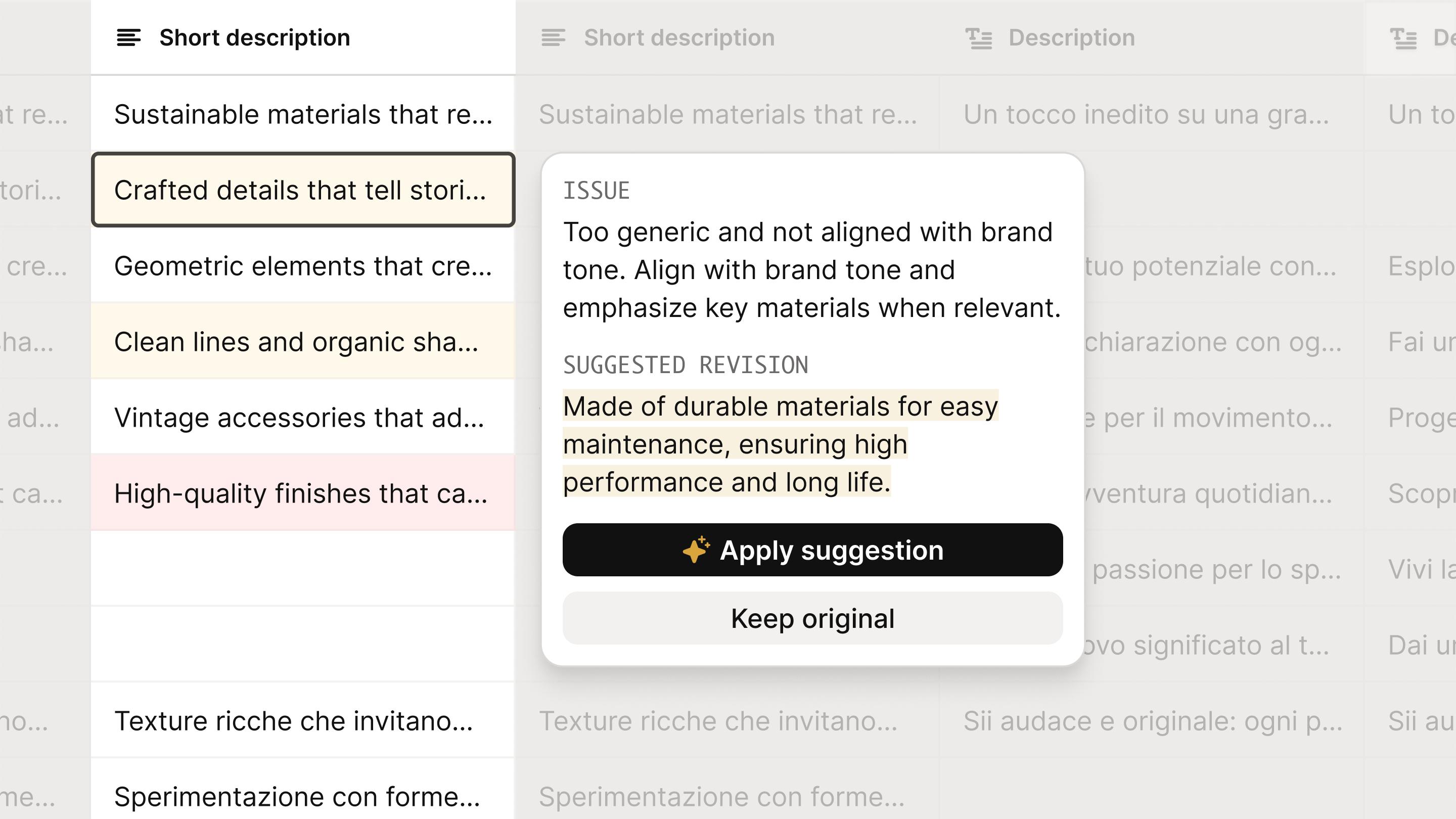
Your rules stop being a document and become an evaluation set: each rule scored across the whole catalog, per rule and per product, conclusion first. What comes back is where you stand, which rule breaks most often and which products break it, rather than ten thousand warnings. The same run covers the rules you wrote and the ones you were given, so anti-greenwashing wording, a missing mandatory statement and brand tone are all checked with one instrument. Then the same rulebook stays on the live catalog: whether products are still live where they should be, whether attributes still agree with your source of truth, whether an image has been swapped by a third party or a description has drifted, whether the feeds are still going out. History comes first, so a change has a before. And where a rule is one you cannot afford to get wrong, it holds the value rather than flagging it.

Claims audit · Pet food
1 held"Grain-free recipe"
Spec sheet §2 attached
"Vet recommended"
Certificate on file
"Hypoallergenic"
No source · held for review
No claim without a source
The feedback loop
Every correction makes the next run better
Your team judges the output. A value is right, or it is wrong and gets fixed once. Each verdict changes the next run: the score on your own sample moves, and the agent starts from what the last one learned. So the share of values that need a person keeps falling, measured on your catalog and your rules rather than on an average of everybody else.
How we work
Live on your catalog in weeks, not months
We run all four phases with your team, on the stack you already have, and each one ends with a number you agreed in advance.
- 01
Design
We map how your data comes in and how the result goes back out, then agree the business KPI the agent has to move.
- 02
Implement
We build the agent and test it on a sample of your own catalog, agreed with you. Every change is scored against that sample, so the tuning runs on numbers.
- 03
Prove
Done means the KPI reached target on the full catalog, and you have seen the numbers yourself.
- 04
Evolve
We stay on the account. Your corrections keep improving the agent, the KPI holds where you need it, and the next use case starts from the context this one already built.

Enterprise, on a catalog you cannot break
It runs on the stack you have
It reads your PIM, ERP and DAM through their APIs and writes the result back to them.
Nothing uncertain reaches a channel
Every value is checked against your rules, and anything uncertain goes to review before it reaches a channel.
Your data stays yours
Your own isolated workspace. It is never pooled into shared models, and you can export it at any point.
Every run is logged
Each value carries its source, its run and its score, so you can see why a wrong one went wrong.
Questions
What retailers ask us
What is product compliance?
Every product record carrying what the market it sells in requires: declarations, labels, restricted substances, documentation. For a retailer the hard part is rarely reading the regulation. It is that every record has to carry the right fields, the rules differ by market, and nobody can check a catalog that size by hand.
Do we have to write our rules down first?
Ideally, and in practice often not. Where a formal guideline exists we run it as it is. Where it does not, the first pass is extracting the rules your team is already applying by hand, so that there is something to test against.
Is this a report or a fix?
The audit is a measurement, deliberately. It tells you how much of the catalog respects the rules and where it does not. Fixing is the other agents’ job, and keeping the two apart is what makes the score worth trusting.
How is a regulatory check different from a brand check?
Only in who wrote the rule. Both run as the same kind of test. The difference is the consequence, which is why regulatory rules are usually set to hold a value rather than to flag it.
What does the monitoring actually watch?
Four things: whether products are still live where they should be, whether attributes still agree with your source of truth, whether images or descriptions have been changed by someone else, and whether the feeds are still going out. Each one is checked against its own history, so a change has a before.
Can it stop something from publishing?
Yes, where you want it to. A rule can flag for review or hold the value outright, and the rules you cannot afford to get wrong are normally set to hold.
Whose data is it?
Yours. The corrections your team makes are what the agents learn from, and both the data and the corrections stay exportable at any point.