Skip to content

Platform · Agents

An agent for your catalog, not a tool to configure.

Every step runs against your attribute model and the bar your team agreed. The agent goes live on one category, then takes on the next, and a person approves anything that reaches a channel.

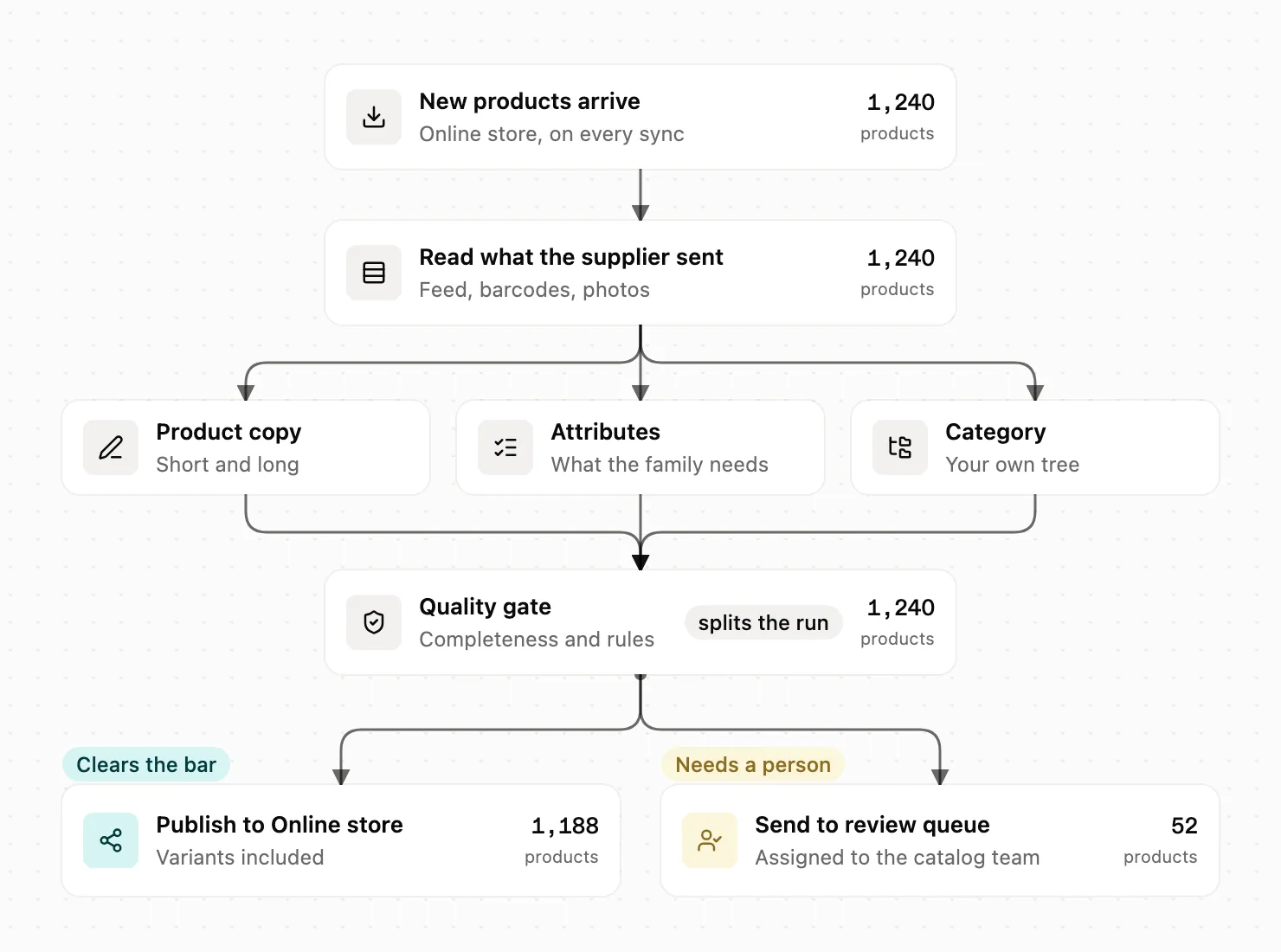
The Product enrichment workflow in the CommerceClarity workflow builder

It starts from your KPIs

You give it the target. It builds the plan.

Bring the number you are measured on and the date you need it by. The agent works out what to read, what to fill, and what to hold for your team.

Your context, not a blank slate
It reads the product and company data you already have. See what it knows.
Your governance, from the first run
The bar and the rules it is scored against are yours. See how it is checked.

Building the workflow

From your KPIs
Apparel has to reach 95% completeness before the new marketplace opens in September. 4,000 products.
Four steps, then. And what I cannot source from your systems, I hold for your team rather than guess.

The workflow it wrote

1Read the feed, the barcodes and the size charts
2Fill what the Apparel families require
3Score every product against the rules
4Under 95% goes to your team, not the channel

After it goes live

It grows without a new project

The agent goes live on one category with three steps, in weeks. Every month after that the Retail Engineer who put it live adds something else, and the bar it clears goes up.

Read it down its own history
Three steps in January, six now, and the date each one arrived.
Someone owns it after launch
A Retail Engineer stays on the account after go-live.

Product enrichment

6 steps

This month

Runs on every sync, 1,240 products a week

July

Added: hold what the gate rejects for the catalog team

May

Added: a second channel, variants included

March

Added: score every product against the brand rules

January

Live on one category. Three steps.

Completeness71%96%since it went live

Human in the loop

A person approves everything that publishes

The agent scores its own work against your bar. What clears it goes to the channel, and the rest waits in a queue with the reason it was held.

The bar is yours to move
Raise it and more comes to you. Lower it and less does.
50, not 1,200
The queue holds only what the agent could not settle.

Review queue

Approve all
Apparel EU412 records · cleared this morningApproved
Home & Living168 records · held on brand toneIn review
Footwear96 records · waiting on the size ruleQueued

Nothing publishes without approval

Questions

Questions we get asked

What is a catalog agent, in practice?
One workflow a retail team does by hand today, now run by software: sourcing an attribute, matching a supplier record, translating a description. Each agent has its own output, its own bar, and its own numbers.
Do we configure the agent ourselves?
No. You bring the number you are measured on and the date you need it by, and the agent works out the steps against your attribute model.
What if the agent we need does not exist yet?
Most already exist as library templates built for other customers, and adapting one to your catalog is part of the service. A brand-new agent is designed with your team and scoped separately.
Does it run on the whole catalog at once?
No. It goes live on one category, proves the number moved, and then takes on the next. Every category it finishes makes the following one cheaper, because the records are already there.
Where does a person come into it?
At the end, where it matters. The agent marks what it could not settle, a reviewer resolves those values in Grid View, and the correction becomes what the agent carries next.

Put an agent on one of your categories

Bring a category, the attributes you never got to fill, and the rules it has to respect. You will see the run and what it holds back for you.