
The problem
A store is a channel with less room
In most retailers the digital catalog stops at the warehouse door, and the store runs on its own content: a name typed to fit the old paper label, a price, and whatever the category manager had time to add. Then the shelf edge became a screen, and could suddenly show anything.
The constraint changed shape rather than going away. A shelf label is read at arm’s length in a couple of seconds, so it is not a shortened product page: it is a different piece of writing, with a hard character budget, the one or two attributes that actually decide the purchase in that category, and the allergen or safety marks the category makes mandatory.
And it is needed for every product, in every store, in the local language, updated whenever the assortment moves. That is the real work, and it is why dynamic shelf content so often launches on one pilot aisle and stops there.
Common use cases
The jobs in the store
Two workflows today. This is the newest of the eight areas, and the list will grow. What runs here feeds the display system and the planogram software you already installed.
Shelf label content
Written for arm’s length
The agent derives shelf content from the same master record the site reads, and writes it to the format the label actually has: a short name that fits the field rather than one truncated by it, the attributes that matter in that category, the promotional flag, and the allergen or safety icons where the category requires them. It runs per store and per language, and it pushes to the display system rather than producing a file for somebody to import. When the assortment or the price moves, the label follows without a person retyping it.

Trail Runner GTX · 8412-M
Enriched24 of 28 attributes · source attached
The feedback loop
Every correction makes the next run better
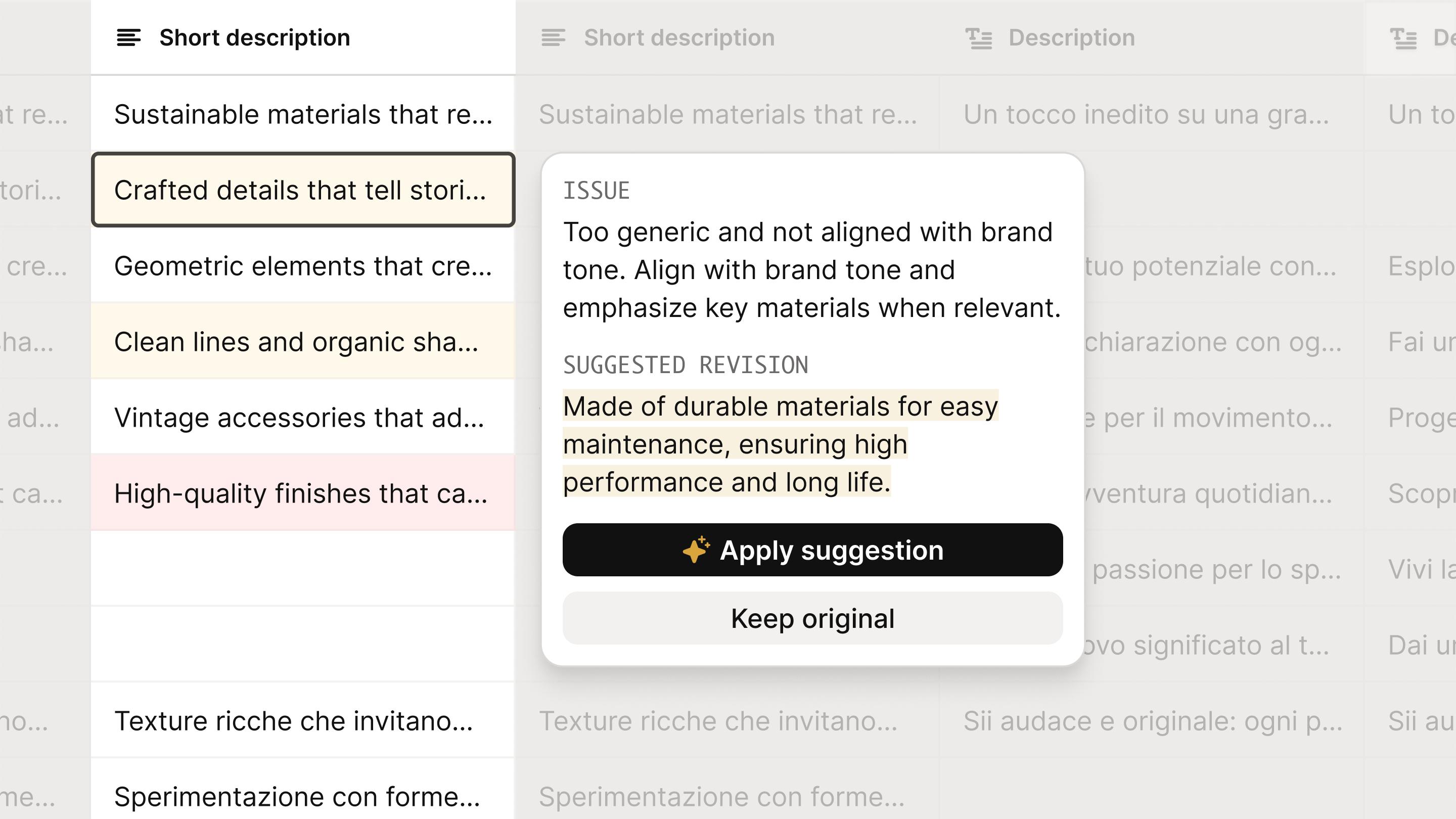
Your team judges the output. A value is right, or it is wrong and gets fixed once. Each verdict changes the next run: the score on your own sample moves, and the agent starts from what the last one learned. So the share of values that need a person keeps falling, measured on your catalog and your rules rather than on an average of everybody else.
How we work
Live on your catalog in weeks, not months
We run all four phases with your team, on the stack you already have, and each one ends with a number you agreed in advance.
- 01
Design
We map how your data comes in and how the result goes back out, then agree the business KPI the agent has to move.
- 02
Implement
We build the agent and test it on a sample of your own catalog, agreed with you. Every change is scored against that sample, so the tuning runs on numbers.
- 03
Prove
Done means the KPI reached target on the full catalog, and you have seen the numbers yourself.
- 04
Evolve
We stay on the account. Your corrections keep improving the agent, the KPI holds where you need it, and the next use case starts from the context this one already built.

Enterprise, on a catalog you cannot break
It runs on the stack you have
It reads your PIM, ERP and DAM through their APIs and writes the result back to them.
Nothing uncertain reaches a channel
Every value is checked against your rules, and anything uncertain goes to review before it reaches a channel.
Your data stays yours
Your own isolated workspace. It is never pooled into shared models, and you can export it at any point.
Every run is logged
Each value carries its source, its run and its score, so you can see why a wrong one went wrong.
Questions
What retailers ask us
What goes on an electronic shelf label?
Price and name, then whatever the shelf has room for: unit price, origin, allergens, an energy class, a promotion. The hardware handles the display. The content comes from the same catalog the website reads, which is why the two drift apart when only one of them is maintained.
Do you replace our label system?
No. The hardware and the display platform stay yours. We produce the content they show and push it there.
Is this just a truncated product name?
No. Truncation is the failure this avoids. A label is written to its own budget, so the words that survive are the ones that decide the purchase rather than the first thirty characters of a web title.
What about price and stock?
They stay with the systems that own them. The agent owns the descriptive content around them, which is the part that was never written per product in the first place.
Can it run per store?
Yes, and that is usually the requirement. Assortment, language and local rules differ store to store, and content that is right in one region can be wrong in the next.
Who checks it before it reaches a shelf?
You do, on the same review the other agents use. A category can be set to publish once it clears the rules, or to hold everything for a person.
Whose data is it?
Yours. The corrections your team makes are what the agents learn from, and both the data and the corrections stay exportable at any point.