
The problem
One description, for everybody who buys it
Most catalogs carry exactly one version of each product’s story, written for a general shopper who does not exist. A technical buyer wants the specification and the compatibility. A first-time buyer wants to know whether it is the right one and what else they will need. A procurement buyer wants neither, and reads past both.
Merchandising is where that costs money rather than clarity. The bundle nobody built, the outfit nobody assembled, the specification that never became a panel a shopper could scan in three seconds: each one is order value left on the table, and each one is manual work that only ever gets done for the top of the range.
The knowledge is already sitting in the record. Materials, dimensions, compatibility, what pairs with what. What is missing is the labour of turning it into more than one presentation, per product, across an assortment nobody has time to work through twice.
Common use cases
The jobs on presentation
A few of the ones that run here. Each is a single workflow with its own output and its own numbers, built from product knowledge you already hold rather than from a brief. Run one, or run the set.
Moving order value
The same record, presented more than once
You define the audiences you actually sell to, and the copy is written for each of them off the same record: the technical read for the buyer comparing specifications, the plain one for the first-timer who needs to know it fits, the procurement version that leads on terms rather than on lifestyle. Every version is written against your own tone of voice and glossary. The same knowledge decides what belongs with what, so bundles, outfits and kits are proposed out of your own assortment with the merchandising rationale and the margin logic attached. And the specifications a shopper will never read as a paragraph get laid out to be scanned. A merchandiser reviews the proposals and approves what publishes.

Review queue
Approve allNothing publishes without approval
The feedback loop
Every correction makes the next run better
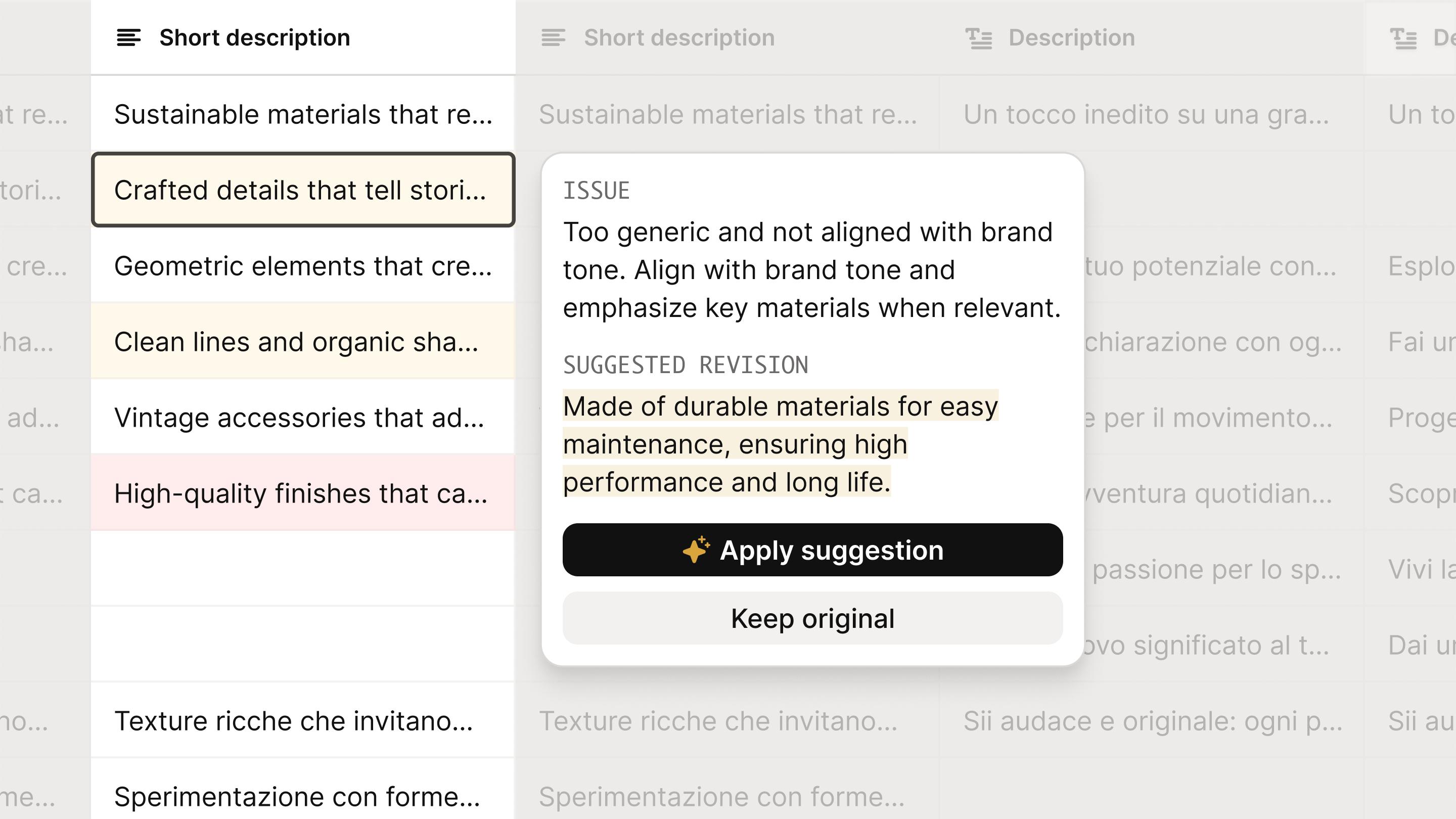
Your team judges the output. A value is right, or it is wrong and gets fixed once. Each verdict changes the next run: the score on your own sample moves, and the agent starts from what the last one learned. So the share of values that need a person keeps falling, measured on your catalog and your rules rather than on an average of everybody else.
How we work
Live on your catalog in weeks, not months
We run all four phases with your team, on the stack you already have, and each one ends with a number you agreed in advance.
- 01
Design
We map how your data comes in and how the result goes back out, then agree the business KPI the agent has to move.
- 02
Implement
We build the agent and test it on a sample of your own catalog, agreed with you. Every change is scored against that sample, so the tuning runs on numbers.
- 03
Prove
Done means the KPI reached target on the full catalog, and you have seen the numbers yourself.
- 04
Evolve
We stay on the account. Your corrections keep improving the agent, the KPI holds where you need it, and the next use case starts from the context this one already built.

Enterprise, on a catalog you cannot break
It runs on the stack you have
It reads your PIM, ERP and DAM through their APIs and writes the result back to them.
Nothing uncertain reaches a channel
Every value is checked against your rules, and anything uncertain goes to review before it reaches a channel.
Your data stays yours
Your own isolated workspace. It is never pooled into shared models, and you can export it at any point.
Every run is logged
Each value carries its source, its run and its score, so you can see why a wrong one went wrong.
Questions
What retailers ask us
What is ecommerce merchandising?
Deciding what to show, to whom, and in what order. The decisions are commercial, but they run on product data. A bundle has to know what goes with what. A description written for one kind of buyer needs attributes to write from. A category page needs its products actually in the category. Poor data caps how good the merchandising can get.
Is this personalization?
Not in the tracking sense. There is no profile and no cookie. These are versions of the copy tied to audiences you define, and they can be served by segment, by channel or by store. Same product, different story.
Do we have to maintain three descriptions per product?
No. You maintain the audiences and the rules. The versions are generated from the record, so a change to the product updates every version at once.
How does a bundle get decided?
From your own assortment and your own margin rules, with the merchandising rationale and the pricing logic attached, so a merchandiser reviews a proposal rather than assembling it.
Does more copy hurt our SEO?
Only if the versions are near-duplicates of each other on the same URL. They are written for different audiences and different surfaces, and where two would collide the canonical stays with one of them.
Where do we start?
With one category and the audiences you can already name, usually the two that argue with each other in a buying meeting. It is a cheap place to see whether the copy moves anything before it goes wider.
Whose data is it?
Yours. The corrections your team makes are what the agents learn from, and both the data and the corrections stay exportable at any point.