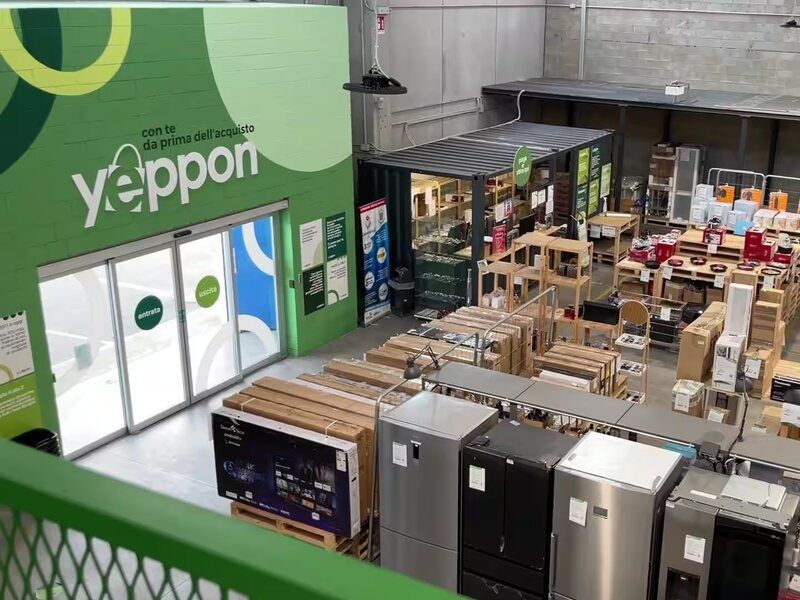

How Yeppon got a 150,000 SKU catalog marketplace-ready, from its own store outward
8x
Faster to market than the manual process
Overview
Yeppon is one of Italy’s leading electronics ecommerce players: 150,000+ SKUs across electronics, appliances, DIY and home furniture, sold on its own store and on more than twelve European marketplaces. Every product is not one listing but a set of variants, different by channel and by language.
The target was both surfaces at once: get the product data right at catalog scale on its own site, and get the catalog onto the marketplaces, starting with Leroy Merlin and Amazon.
The challenge
Before us the catalog was largely a manual job. A part-time resource added new SKUs, enrichment leaned on a third-party feed and on whichever suppliers sent good data, and filters like screen size, RAM and disk were pieced together by hand. Around seventy per cent of listings got created or updated, many with no photo, on an irregular cadence.
For fifteen years the economics concentrated the real effort on the twenty per cent of the catalog around Apple, appliances and TVs. The rest went to the marketplaces matched on price and availability alone, never enriched.
A partner already ahead on AI
Yeppon is one of the most AI-forward teams we work with. They had already built their own ChatGPT agents to write titles, descriptions and bullet points. That instinct took them a long way, and then hit the limits of the tool: output that would not stay consistent run to run, gaps filled from the model’s training rather than from the product, images slow and expensive at catalog scale, and no proof a listing would clear a marketplace’s quality bar before it went up.
A catalog is a harder problem than a front end. Tens of thousands of products, a quality bar that keeps moving, and results that have to stay provable run after run. That is a system to engineer, not a tool to run.
How we solved it, agents and a Retail Engineer
First, their own store
Yeppon runs its store on Shopify, built by the team itself. The agents fill in each product, its details, specs and images, and file it under the right category, through an API integration into Yeppon’s own flows. It went live on the Apple range first, proved out on a batch, then rolled across the catalog, and today it runs on its own.
Then, the marketplaces
Every marketplace is a walled garden with its own rules. Three things made this hard. Leroy Merlin scores listings and only publishes above the bar, and Yeppon sat well under it, so close to half the catalog could not be listed cleanly. Nobody hands you the formula, not even the marketplace’s own team. And the numbers are big: around 37,000 brands to match to their codes, and 63,000 product details to fill.
- Match Yeppon’s brands and barcodes to the marketplace’s own product codes.
- Create listings for products not on the marketplace yet.
- Improve existing listings on what actually lifts the score: filled-in details, images, specs, required fields.
- Check against the bar before anything goes up.
The same agents work on any category. They were proven on four to start, drills, planters, garden hoses and hose reels, then pointed at the rest. This phase is still running: around 24,000 products are live across channels so far, roughly 19,000 on Leroy Merlin and 5,000 on Amazon.
The Retail Engineer
The agents do not work alone. A CommerceClarity Retail Engineer works as an extension of Yeppon’s team, the same person scoping, building and shipping, inside the way Yeppon already operates. It also gave the catalog something it had gone without for fifteen years: a dedicated owner. Yeppon’s marketing team stays in command, and every generated listing passes human review before it goes online.
Before and after
The do-it-yourself approach against the system that replaced it.
In their words
A team that already knew where AI stops
“We had built our own agents on ChatGPT before this, so we knew where AI helps and where it stops. The agents handle the volume across the full catalog, but every listing still passes our team’s review before it goes live. We got the scale without giving up the final call on quality.”

“It connects straight into our flows through the API, so we shape content around what each product actually needs instead of running one template across the board. The same product can go out with a different angle on Amazon than on Leroy Merlin, and the speed holds even when we switch language.”